This piece from More Perfect Union doesn't just report on a tech company; it exposes a quiet revolution where a single firm is positioning itself to become the central operating system for the American government, the military, and even private healthcare. The most startling claim isn't that Palantir has powerful software, but that its founders view the current political moment not as a risk, but as a necessary condition for their dominance, explicitly designing their business model to thrive on "bad times" and societal unrest.
The Architecture of Domination
More Perfect Union begins by dismantling the sanitized sales pitch of data analytics, revealing a company culture built on a philosophy of total control rather than mere efficiency. The author notes that while the company claims to "revolutionize government systems," the underlying mission is far more aggressive. "I don't think in win lose. I think in domination," the piece quotes Palantir CEO Alex Karp, a sentiment that frames the company's entire existence as a tool for asserting power over chaos. This is not the language of a neutral service provider; it is the rhetoric of an entity seeking to define reality itself.
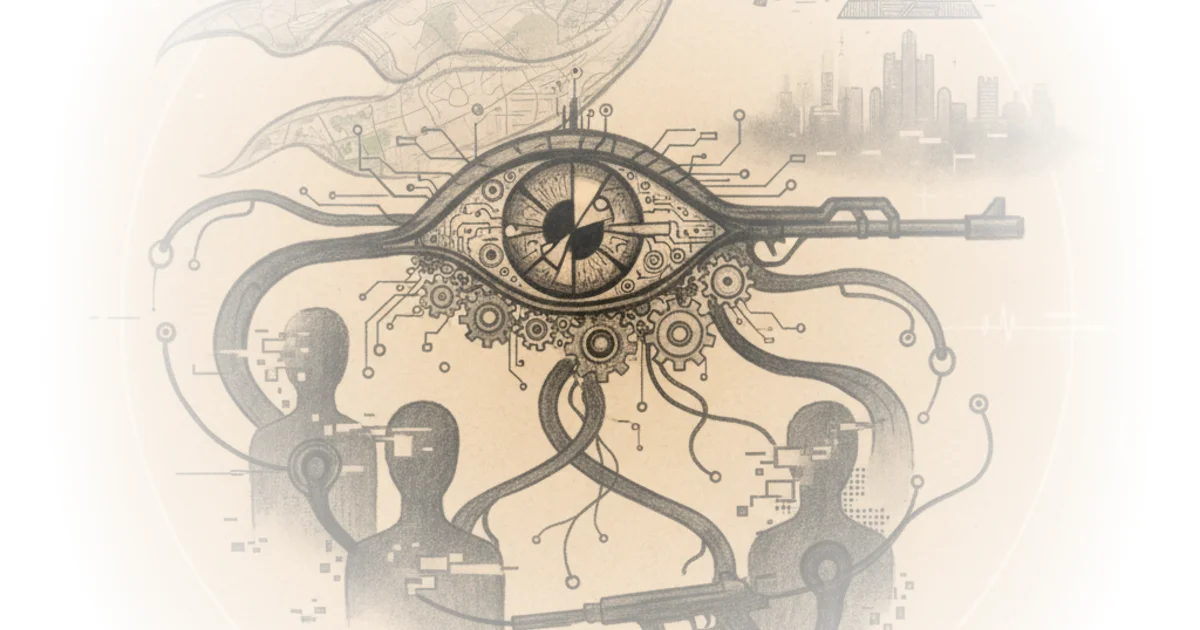
The commentary highlights how Palantir capitalizes on the post-9/11 expansion of surveillance, merging the fraud-detection logic of PayPal with the lethal ambitions of the defense industry. More Perfect Union writes, "Bad times mean strong finances internally. Bad times are very good for Palantir because we built products that are robust, that are built for danger." This framing is crucial: it suggests that the company's profitability is directly tethered to global instability and fear. While critics might argue that national security requires robust tools regardless of the geopolitical climate, the article effectively argues that Palantir's specific business model incentivizes the persistence of the very threats it claims to solve.
"We are very comfortable being unpopular. Whatever is pissing them off, they're still buying the product."
The piece traces the company's evolution from a tool for tracking terrorists to a ubiquitous platform used by the IRS, health insurance companies, and fast-food chains. This expansion is presented not as accidental growth, but as a strategic move to embed the company into the fabric of daily life. The author points out that Palantir's software can "completely reconfigure organizations ontology, its reality, what systems matter, what information matters." This is a profound observation: the software doesn't just process data; it dictates what questions are asked and what answers are considered valid. By controlling the data ontology, Palantir effectively controls the decision-making process of its clients.
The Convergence of Tech and State Power
The most significant portion of the analysis focuses on the alignment between Palantir's ambitions and the current direction of the executive branch. More Perfect Union details how the company has positioned itself as the ideal partner for a government seeking to streamline operations and centralize data. The article notes that the Department of Defense's advisory board has cited Palantir's own white papers to justify diverting massive budgets toward emerging technologies. "Turning to government, we continue to advance our mission of becoming the US government's central operating system," the piece quotes CTO Shyam Sankar. This is a clear declaration of intent: Palantir does not want to be a vendor; it wants to be the infrastructure upon which the state runs.
The commentary draws a sharp line between the company's rhetoric of "disruption" and the potential consequences of such centralization. The author warns that as the government adopts these systems, we risk moving toward "governance by algorithm," where human decisions are subordinated to automated systems designed by a private entity with a distinct agenda. More Perfect Union writes, "It almost feels like that's been the plan all along," referencing co-founder Peter Thiel's 2010 assertion that technology could be used to "unilaterally change the world without having to constantly convince people." This historical context adds weight to the current news, suggesting that the current political alignment is not a coincidence but the fulfillment of a long-held strategy.
A counterargument worth considering is that the complexity of modern government data requires a unified system to prevent fraud and inefficiency, and that Palantir is simply the most capable provider. However, the article effectively counters this by highlighting the lack of transparency and the concentration of power. The piece notes that Palantir's founders retain nearly 50% of voting power through a special share structure, meaning they can dictate the company's direction regardless of shareholder interests or public scrutiny. "The founders of Palantir will retain control in the company no matter what," the author states, underscoring the democratic deficit inherent in this arrangement.
The Human Cost of Algorithmic Reality
The narrative concludes by focusing on the human element, specifically the experiences of former employees who have spoken out against the company's practices. The piece highlights the ethical dissonance of using AI to select targets in war zones, citing evidence of Palantir's involvement in the conflict in Gaza. "If you do not feel comfortable supporting the legitimate efforts of America and its allies in the context of war, don't join Palantir," the author quotes the company's internal messaging. This creates a culture where dissent is discouraged and ethical concerns are framed as a lack of patriotism.
More Perfect Union argues that the true danger lies not just in the technology itself, but in the normalization of its use. "We're all kind of used to government surveillance. The idea that we're all being watched all the time and don't own our own personal data has become normalized." The article suggests that Palantir is the vanguard of this normalization, pushing the boundaries of what is acceptable until the "ultimate orbiter of all of our data" becomes an unremarkable fact of life. The author's final warning is stark: "We can't replace our current broken system with an even more broken one. And we can't let the worst people in Silicon Valley become our government."
"When you're able to take a step back and really see all the narratives and how they were shaped and the actual application of these technologies, your whole world starts falling apart."
Bottom Line
More Perfect Union delivers a compelling and unsettling portrait of a company that has successfully merged the profit motives of Silicon Valley with the lethal capabilities of the military-industrial complex. The piece's greatest strength is its ability to connect historical context with current events, showing how Palantir's rise is not an anomaly but a calculated outcome of decades of strategic positioning. However, the argument's biggest vulnerability is its reliance on the assumption that the current political alignment is permanent; the future of this partnership depends heavily on the longevity of the specific administration and the political will to centralize data in this manner. Readers should watch closely for how the Department of Defense and the IRS implement these new systems, as the shift from pilot programs to full-scale operational control will be the true test of this "central operating system" vision.