Ancient DNA has finally cracked the code on Pompeii's most haunting artifacts, revealing that the intimate family dramas we projected onto plaster casts for a century were largely fiction. Razib Khan guides us through a groundbreaking Cell paper that uses paleogenetics to dismantle decades of archaeological storytelling, proving that the victims of Vesuvius were not a nuclear family, but a diverse group of unrelated men. This is not just a correction of the record; it is a fundamental shift in how we understand the social fabric of Imperial Rome, moving from romanticized narratives to hard biological data.
The Death of the Nuclear Family Myth
Khan opens by setting the stage with the visceral reality of the 79 AD eruption, noting how the disaster froze a vibrant society in a single afternoon. He highlights the enduring power of the plaster casts, created in 1863 by Giuseppe Fiorelli, which have long served as the emotional anchor for our understanding of the tragedy. "The eloquence of those often anguished, unaffected final human gestures naturally move us to sympathize with them far more powerfully than we relate to those who fled," Khan writes, acknowledging why these images have captivated the public imagination for so long. The casts seemed to offer a window into the private lives of ordinary citizens, far removed from the marble busts of emperors.
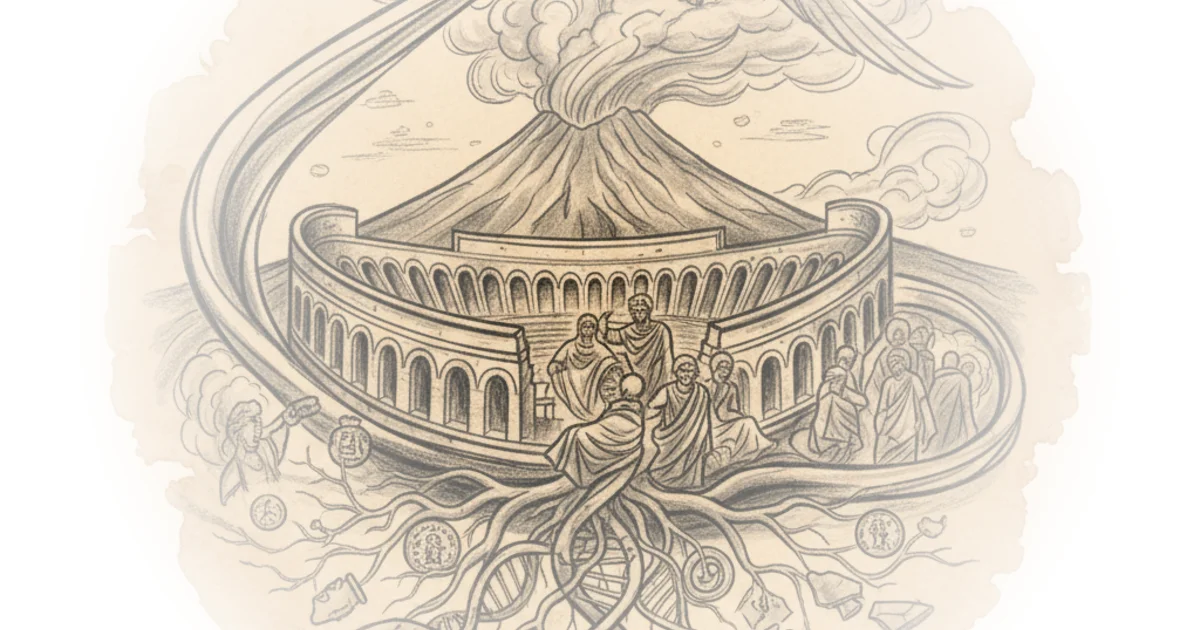
However, the new genetic evidence shatters the specific narratives built around the most famous cast group: the "House of the Golden Bracelet." For fifty years, archaeologists interpreted the scene as a wealthy mother protecting her child, with a father and another child nearby. The visual cues—the pose, the jewelry, the size of the figures—seemed to tell a clear story. Khan points out the sheer audacity of the new findings: "One of the simplest things to test immediately upends some of our emotional interpretations of the figures and their poses: all five individuals are indisputably male, as attested by their Y chromosomes."
This revelation forces a complete rewrite of the history of that specific room. The figure wearing the massive gold snake bracelet, long assumed to be a maternal protector, was actually a man. The child on his lap was not his offspring, nor was the other adult nearby related to them. Khan explains that the genome-wide analysis shows these individuals were "entirely unrelated individuals" who happened to die in the same building. This suggests that the social unit of Pompeii was far more fluid and perhaps more desperate in its final moments than the tidy nuclear family model implies. Critics might argue that the absence of biological kinship does not preclude a social family unit, but the sheer lack of genetic ties among those huddled together in a wealthy home challenges the assumption that the elite lived in isolated domestic bubbles.
A Genetic Census of the Empire
The study's scope extends beyond correcting a single family tree; it offers a rare glimpse into the demographic reality of the Roman world. Khan notes that the region was a cosmopolitan hub, yet our mental image of Pompeii often defaults to a homogenous Italian population. The genetic data, however, reveals a different story. "All the evidence then points to the three fully genotyped individuals in the House of the Golden Bracelet being entirely unrelated individuals... and what's more, with a very diverse range of origins," Khan states.
This aligns with the broader historical context of the Flavian dynasty. Khan reminds us that the emperor Vespasian, who ruled at the time of the eruption, was a "humble Italian from a town northeast of Rome" with no roots in the capital, marking a shift where military achievement superseded lineage. The diversity found in the victims reflects an empire that was already deeply integrated, long before the modern era. The presence of individuals with different biogeographic ancestries in a single elite household underscores the mobility and interconnectedness of the Mediterranean world. As Khan puts it, the study allows us to "precisely delve into their genetic backgrounds and relationships," transforming vague speculation into concrete data.
"The possible life narratives their final moments suggest to the fertile human imagination have grown rich enough... to serve as the basis for numerous documentaries in the late 20th and early 21st centuries."
The contrast between the romanticized documentaries and the cold genetic reality is stark. Khan argues that the "vivid details amid calamity" have always offered an "irresistibly human-scale counterpoint" to the cold perfection of Roman material culture. Yet, the new data suggests that the human stories we told ourselves were projections. The victims were not a mother and child, but a group of men—perhaps friends, colleagues, or strangers seeking shelter—who were united only by the catastrophe. This does not diminish their tragedy; if anything, it makes it more poignant. They were not a family unit preserved by love, but a collection of individuals whose lives were abruptly and indiscriminately ended.
The Limits of Imagination
The article also touches on the broader implications for how we study the past. Khan emphasizes that while the plaster casts provide a "solidified concrete-like mass studded with human-shaped cavities," they are silent on the biological reality of the people inside. The technology of the 19th century captured the form, but only the technology of the 21st century can reveal the substance. "Today, though, we have at hand a powerful new way to understand those people of the past, no matter where we find them or how their final gestures strike us: their genetic interrelationships," Khan writes.
This shift from visual interpretation to genetic analysis represents a new frontier in archaeology. It forces historians to confront the possibility that their most cherished narratives are built on assumptions rather than evidence. The study of the House of the Golden Bracelet is just the beginning. As Khan notes, the research team was able to retrieve DNA from seven casts, and the potential for further discoveries is immense. The "ghost population" of Pompeii is no longer a mystery to be solved by imagination, but a dataset to be analyzed by science.
Bottom Line
Razib Khan's review of this Cell paper delivers a powerful corrective to the sentimentalized view of Pompeii, replacing a century of family-based storytelling with a more complex, diverse, and historically accurate reality. The strongest part of the argument is the use of Y-chromosome data to definitively disprove the "mother and child" narrative, a move that fundamentally alters our understanding of Roman social structures. The biggest vulnerability lies in the potential for over-correcting; while biological kinship is absent, the social bonds that brought these men together in that room remain a valid, if unprovable, historical question. Readers should watch for how this genetic lens is applied to other ancient sites, as it promises to rewrite the family trees of history itself.