Jimmy Alfonso Licon, a philosophy professor at Arizona State University, turns the holiday season into a rigorous logical puzzle, arguing that the most compelling reason to doubt Santa Claus isn't his physical impossibility, but the moral inconsistency of his gift-giving record. While most skeptics focus on logistics or physics, Licon suggests the real evidence lies in the millions of good children who receive nothing—a pattern that mirrors the ancient theological crisis of why a benevolent deity allows suffering.
The Logical Flaw in the Naughty List
Licon begins by dismantling the standard objections to Santa's existence, noting that they rely on assumptions about human limitations that a magical figure might simply bypass. He writes, "Although it is obvious that Santa Claus doesn't exist, the reasons often given for this disbeliefs are less sound than is often appreciated." He points out that claims about the impossibility of global travel in one night fail if one grants Santa the ability to manipulate time, and arguments about parents buying gifts don't account for the possibility that Santa provides some gifts. This is a crucial pivot: Licon isn't trying to prove Santa is a human in a red suit; he is testing the internal logic of the Santa mythos itself.
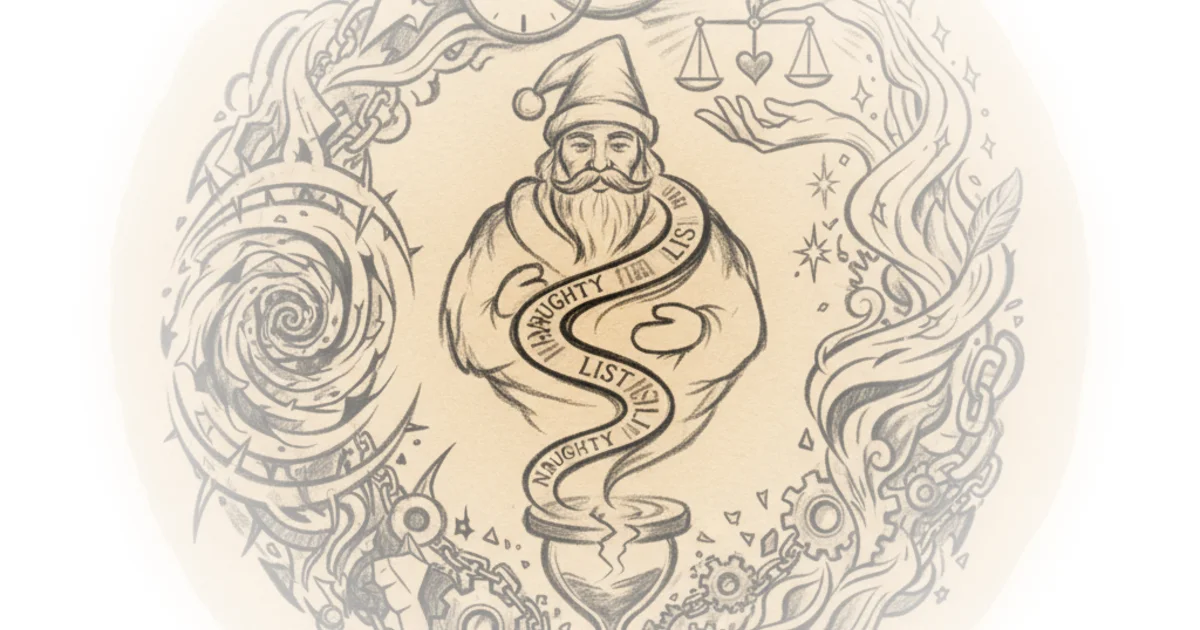
The core of Licon's argument shifts from physics to ethics. He posits that Santa's essential nature is defined by moral desert—rewarding the good and punishing the bad. He cites the classic carol to ground this: "He knows if you've been bad or good, so be good for goodness sake." If this definition holds, the distribution of gifts should perfectly align with a child's behavior. Yet, the empirical reality contradicts this. Licon formulates the argument clearly: if Santa exists, all deserving children receive gifts; but many deserving children receive nothing; therefore, Santa does not exist. This lands with significant force because it moves the debate from "can he do it?" to "would he do it?"
If Santa exists, then all deserving children would receive something for Christmas. But many deserving children receive nothing for Christmas. Therefore: There is no such person as Santa.
Critics might note that this argument relies on a specific, perhaps overly rigid, definition of Santa that ignores the nuance of modern folklore where Santa is often portrayed as generous to all children regardless of merit. However, Licon anticipates this by distinguishing between the act of asking a child what they want and the act of delivering it, arguing that the former does not negate the moral obligation of the latter.
The Shadow of Krampus and the Problem of Evil
Licon then elevates the discussion by drawing a direct parallel to the "Problem of Evil," a debate dating back to the Ancient Greek philosopher Epicurus (341-270 B.C.). Just as theologians struggle to reconcile a loving, all-powerful God with pointless suffering—like a fawn dying alone in a forest—Licon asks how a loving, all-powerful Santa can coexist with the suffering of good children who get no gifts. He writes, "The problem of evil is only a problem, however, if there really is such a person as God. The problem we explore... has a similar structure: it is only a mystery why so many good child who receive any present whatsoever if Santa actually exists."
This comparison is the piece's most distinctive move. By mapping the theological dilemma onto a children's holiday figure, Licon exposes the absurdity of using "mystery" to excuse moral failures. He addresses the counter-argument that Santa might have unknowable reasons for withholding gifts, stating, "If he is so mysterious that his reasons are beyond comprehension, then nearly all Santa-talk would be unfounded." If we cannot understand Santa's motivations, we cannot make any claims about his character at all. This effectively shuts down the "God of the gaps" defense often used in theology.
The argument takes a darker, more creative turn when Licon introduces the Krampus, the half-goat, half-demon figure from Central and Eastern Alpine folklore who punishes naughty children. He suggests that the lack of gifts for good children might not just disprove Santa, but actually support the existence of a malevolent force. He writes, "Perhaps the fact that many good children get nothing for Christmas isn't just robust evidence against the existence of Santa Claus, but also evidence for The Krampus." In this twisted logic, the Krampus might be allowing some goodness to exist only to make the eventual suffering or deprivation more profound, a concept Licon links to the "Evil God" hypothesis in philosophy.
A Moral Verdict on the Season
Ultimately, Licon concludes that the evidence points not to a perfect Santa, but to a flawed or non-existent one. He suggests that if Santa does exist, he may be "intermittently good" with "mixed moral character," sometimes on the nice list and sometimes on the naughty list. This reframing strips away the sentimental certainty of the holiday and replaces it with a stark ethical evaluation. As Licon puts it, "To put in holiday appropriate terms: perhaps Santa is sometimes on the nice list, and other times on the naughty list."
The strength of this piece lies in its ability to use a playful premise to expose serious logical inconsistencies in how we justify unexplained suffering. By treating Santa as a philosophical case study rather than a cultural icon, Licon forces the reader to confront the uncomfortable gap between our moral expectations and the reality of the world. While the argument is a thought experiment, it serves as a sharp critique of theodicy—the attempt to justify God's goodness in the face of evil—by showing how easily the logic collapses when applied to a figure we are willing to laugh at.
Perhaps the fact that many good children get nothing for Christmas isn't just robust evidence against the existence of Santa Claus, but also evidence for The Krampus.
Bottom Line
Licon's strongest contribution is the application of the "Problem of Evil" to Santa Claus, which effectively neutralizes the common defense that "we just don't understand his reasons." The argument's biggest vulnerability is its reliance on a specific, moralistic definition of Santa that modern culture has largely abandoned in favor of a more indiscriminate generosity. Readers should watch for how this logical framework might be applied to other cultural narratives that rely on unexplained benevolence to function.