Mick Ryan, the retired Australian Army major general whose war commentary has become something like required reading for serious followers of the Ukraine and Iran conflicts, uses this week's dispatch to issue a warning that should land harder than it probably will. Despite spectacular tactical metrics on both fronts, Ryan argues, neither war has a coherent political strategy attached to it. The effectiveness is real. The direction is not.
The Strategic Mismatch
Ryan's central claim is compressed into a single sentence that does most of the essay's analytical work.
"Military power unmoored from coherent political objectives, good strategy and alliance management produces strategic outcomes that undermine the original war aims."
The context is Operation Epic Fury, where 12,300 targets have been struck, the Iranian navy has been destroyed, and Khamenei has been killed. By any tactical measure the campaign is a triumph. Ryan argues that none of that answers the strategic question of what success looks like. He is particularly skeptical of the administration's 48-hour ultimatums on the Strait of Hormuz, which he treats as rhetorical pressure divorced from achievable objectives. "Military statistics," he writes, "are insufficient for strategic assessment."
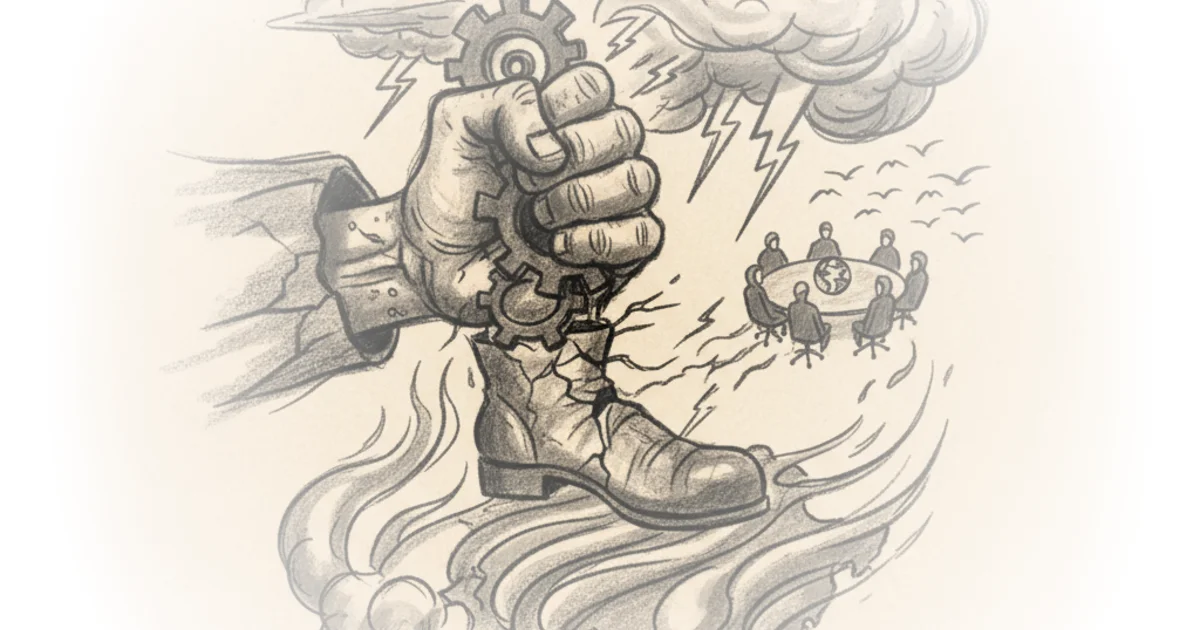
Ryan then reaches for J.C. Wylie's principle about the soldier on the ground being the ultimate determinant of war, and adapts it pointedly: "The ultimate determinant in war is the man on the scene with a gun: the administration risks breaking not Iran's will, but its own." The formulation is elegant and quietly devastating. It suggests that the political class directing Epic Fury may crack before the regime it is trying to crack.
When Ground Forces Make Sense—And When They Don't
On the question of potential U.S. land operations, Ryan is clear. "Ground forces can be decisive," he writes, "but only when employed at scale, against the right mission, with clear political objectives. None of those conditions are obviously present at the moment." The warning is directed at anyone reading the tactical successes as permission to escalate into occupation. Ryan has seen this movie before, and he doesn't want anyone pretending the ending is different this time.
The alliance picture compounds the problem. Spain closed airspace to Epic Fury operations. Italy denied basing. Germany declined involvement. Ryan reads this as evidence of a deeper shift. "The era of American security extended as a matter of solidarity," he writes, "regardless of allied contribution, is over." The European refusals aren't a coordination failure; they are a forecast.
The Ukraine Innovation Story
The dispatch's second half pivots to Ukraine, and here Ryan sounds almost optimistic despite himself. The drone numbers are remarkable—strikes penetrating 1,400 kilometers into Russian territory, production scaling from 2,000 unmanned ground vehicles in 2024 to a projected 40,000 in 2026. Russian losses in March hit record levels, with drone strikes alone producing roughly 34,000 casualties. Russia has responded by compressing infantry training from a month to a week, which Ryan describes as a desperate measure that will degrade assault quality without solving the underlying manpower problem.
The most strategically significant detail is Ukraine's Mediterranean campaign. "Russia's shadow fleet," Ryan writes, "estimated at over 3,000 vessels, is the primary mechanism for Moscow to circumvent Western energy sanctions." Ukrainian drone operations launched from Libyan bases are starting to target that fleet. If it works, it represents a genuine structural blow rather than another tactical headline. Ryan also flags AI-powered drone swarms, noting that "the technical prerequisites are already in development at Ukraine's frontline workshops." Desperation is accelerating innovation faster than doctrine can absorb it.
Where The Essay Is Thin
Ryan's analytical framework is sharp, but he leaves several important questions under-explored. The China dimension is the biggest. If the administration becomes strategically overextended in Iran, Beijing's Taiwan timeline potentially compresses, and Ryan notes the unconfirmed U.S.-Xi summit date without pushing further into the implications. The essay would be stronger with a clearer statement about how much of Epic Fury's strategic cost is being paid in the Pacific rather than the Gulf.
The domestic political dimension is also missing. American public appetite for protracted Middle Eastern commitment is historically limited, and that constraint is going to assert itself regardless of what Iranian negotiators do. Ryan's framework is almost entirely about military and alliance dynamics; the civilian pressure that will eventually force a settlement deserves more weight.
On Iran itself, Ryan treats the regime as a unitary actor. Internal factional dynamics—between the IRGC, the clerical establishment, and whatever remains of the civilian government—could produce collapse or compromise on schedules that have nothing to do with external military pressure. The possibility that the war ends from inside Iran rather than outside it doesn't get the attention it deserves.
Finally, the Russia-Iran coordination angle is only briefly mentioned. If Moscow commits meaningful military advisors or capabilities to Tehran, the conflict changes character entirely, and that scenario deserves more than a passing sentence.
Bottom Line
Mick Ryan has produced the week's clearest warning about the gap between tactical success and strategic coherence. The Wylie-inspired line about breaking one's own will rather than the enemy's is the kind of formulation that should end up in every serious briefing on Epic Fury. Readers should treat Ryan's framework as the baseline for evaluating the coming weeks of news: impressive metrics are not the same as strategy, and alliance fractures are not coordination failures. His blind spots on China, domestic politics, and Iranian internal dynamics don't undermine the central argument. They just leave room for the next dispatch to be even sharper.