Fred Mills doesn't just report on a construction project; he exposes a $13 billion collision between Texas's car-centric identity and its crumbling reality. While the headline screams about highway expansion, the real story is a desperate, expensive gamble to save a city that literally cannot drain its own rainwater. This is not a standard infrastructure update; it is a forensic look at how a century of prioritizing asphalt over adaptation has created a "death trap" that now demands a fortune to fix.
The Anatomy of a Disaster
Mills begins by stripping away the optimism often associated with public works, immediately grounding the narrative in the human cost of inaction. He notes that Interstate 45 is "one of the deadliest highways in America," citing over 100 fatalities in 2023 alone. The author's framing is effective because he refuses to treat these as isolated accidents, instead labeling the route a "death trap" that the state has finally decided to address. This sets a high stakes tone, forcing the reader to acknowledge that the $13 billion price tag is a response to a crisis, not just a routine upgrade.
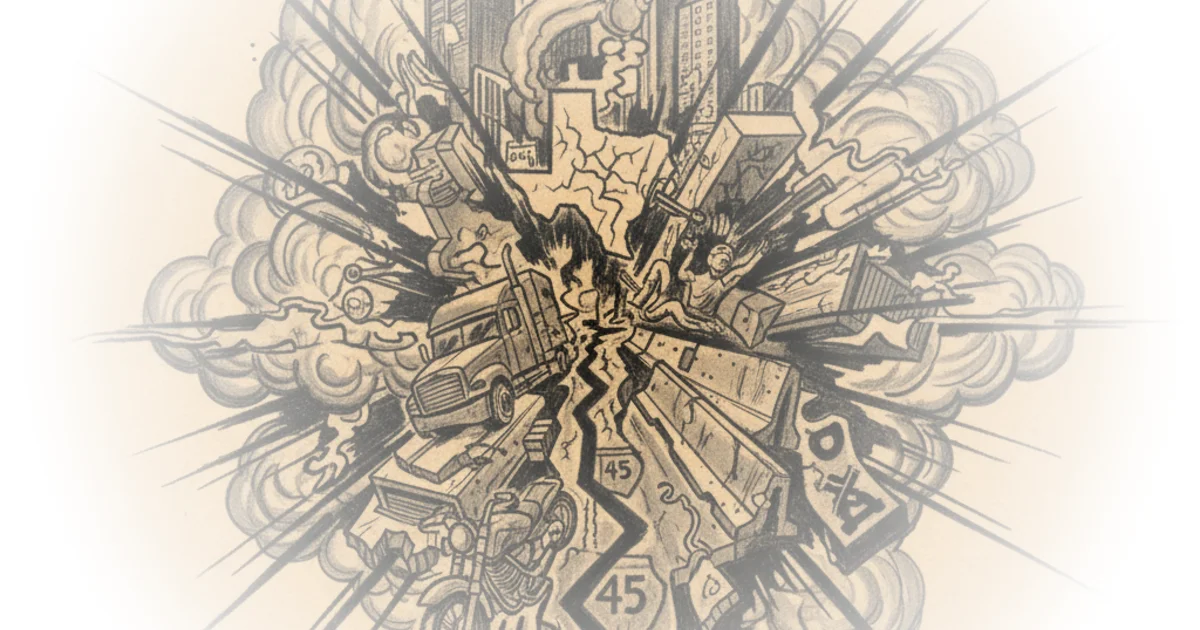
However, the true genius of Mills' coverage lies in connecting the traffic fatalities to Houston's unique geography. He explains that the city sits on "soft clay-based soil" just 40 feet above sea level, a topography that turns heavy rain into a disaster when combined with non-absorbent concrete. "Mix heavy rain with poor drainage, and you've got a recipe for disaster," he writes. This is a crucial insight often missed in standard reporting: the highway isn't just a road; it is a failing component of the city's flood control system. By highlighting that the current infrastructure "doesn't even meet current roadway design standards" and cannot serve as a hurricane evacuation route, Mills makes the expansion feel like a matter of survival rather than mere convenience.
Critics might argue that spending billions on a car-centric solution ignores the root cause of the problem: the lack of public transit. Yet, Mills acknowledges this tension early, noting that the project is a direct result of America's "long and enduring love affair with the car." He points out that when the Gulf Freeway was built, it actually replaced an existing electric train line, a historical pivot that locked the region into a car-dependent future.
"The Texas Department of Transportation should be investing in transportation and not highways. There's like a joke that we say like Texas Department of Highways, like not Texas Department of Transportation because that's all that they that they do."
This quote, drawn from local frustration, serves as the article's emotional anchor. It validates the skepticism of residents who see the expansion as doubling down on a failed strategy. Mills uses this to pivot from the technical necessity of the project to the political reality of its execution.
The Human Cost of Concrete
The most disturbing section of the piece is not the engineering, but the social engineering. Mills shifts focus to the neighborhoods that will be carved up to make room for the new lanes, revealing that "hundreds of businesses, thousands of homes, schools, places of worship, parkland, all of it is going to disappear." The author does not shy away from the historical context, noting that researchers have found "clear government intent to route highways through low-income and minority neighborhoods."
He highlights a specific, painful reality: "This project was clearly racist," as one community member states, pointing out that the route goes "directly through the heart of historic fifth ward." Mills effectively contrasts the official narrative of "economic development" with the lived experience of displacement. While the Texas Department of Transportation (TexDOT) denies claims of racism and promises $30 million in assistance, Mills presents the counter-narrative of residents who feel their voices are being ignored. "They think that there they might be able to get away with this because it is disenfranchised and underserved communities that people won't listen to," he paraphrases, capturing the deep distrust between the state and its citizens.
The scale of the proposed changes is staggering, with some sections of the highway potentially becoming "up to a massive 20 lanes wide." Mills describes the plan to completely reroute the interstate, moving it from the west of downtown to the east, a move that will require demolishing existing structures to align with other major arteries. The visual of "huge concrete boxes known as culverts" being placed to channel water away from streets underscores the sheer physical disruption required to solve a drainage problem that should arguably be addressed through land-use policy rather than just wider roads.
"People's lives are going to be changed forever. And the question that stop text dot are asking is why is this project happening at all?"
This rhetorical question cuts to the core of the controversy. Mills juxtaposes the federal government's recent decision to cut a high-speed train grant between Houston and Dallas—labeled a "waste of taxpayer funds"—against the massive state investment in highway expansion. The irony is palpable: while other parts of the US are removing highways, Texas is building them to monumental proportions.
Bottom Line
Mills' coverage is strongest in its refusal to separate the engineering from the sociology, revealing that the $13 billion project is as much about managing a legacy of segregation as it is about moving cars. The argument's biggest vulnerability is its acceptance of the premise that a wider highway is the only viable solution, given the city's geography and projected population growth. The reader should watch for whether the promised community dialogue actually alters the final plan, or if the momentum of the bulldozers will simply overwhelm the voices of the displaced.