Most self-help narratives treat midlife as a crisis to be fixed, a glitch in the system requiring a quick patch. Maria Popova reframes this entirely, presenting the middle years not as a decline but as a necessary, terrifying, and ultimately redemptive "Middle Passage" where the provisional self must die so the authentic self can emerge. Drawing on the dense psychological framework of James Hollis, the piece argues that the pain of this era is not a sign of failure, but a functional signal that the strategies of youth have finally collapsed under the weight of reality.
The Architecture of the False Self
Popova anchors her analysis in the collision between our "acquired persona" and our "true self." She notes that Hollis views the first half of life as a period of adaptation, where we build a personality to survive childhood traumas and cultural demands. This is not a flaw, but a survival mechanism that eventually becomes a cage. As Popova writes, "One has entered the Middle Passage when the demands of the true self press restive and uprising against the acquired persona, eventually colliding to produce untenable psychic ache."
The commentary here is sharp: it identifies the source of modern malaise not as a lack of achievement, but as the exhaustion of a mask that no longer fits. Hollis suggests that our early conditioning creates a "conditional life" where we mistake our survival strategies for our identity. Popova highlights this by quoting Hollis: "Perhaps the first step in making the Middle Passage meaningful is to acknowledge the partiality of the lens we were given by family and culture, and through which we have made our choices and suffered their consequences."
This framing is effective because it removes the stigma of the "midlife crisis." Instead of a personal failing, it is a structural inevitability. However, critics might note that this psychological depth can feel inaccessible to those in immediate survival mode, where the luxury of introspection is unavailable. The argument assumes a level of safety and resources that not all readers possess.
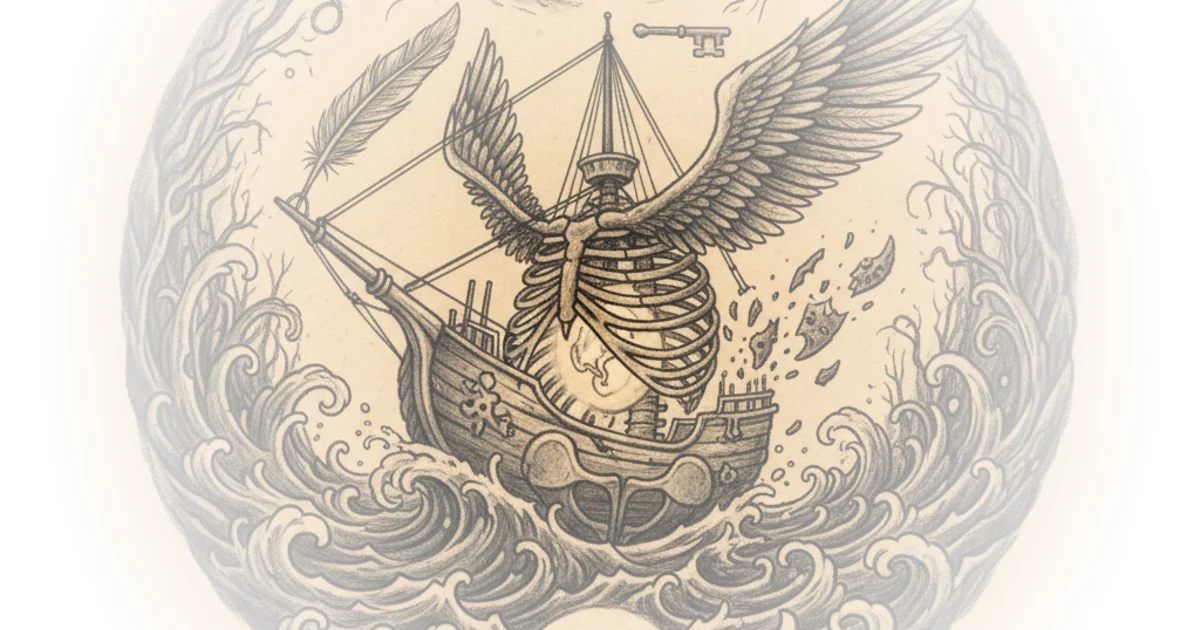
The person one has been is to be replaced by the person to be. The first must die... Such death and rebirth is not an end in itself; it is a passage.
The Mechanics of Projection
The piece pivots to the mechanics of how we relate to others, arguing that our relationships are often mirrors of our own unhealed wounds. Popova explains that what we often call "love" is actually a projection of our own unclaimed parts onto another person. This is where the historical context enriches the argument; Popova connects Hollis's Jungian theory to the broader literary tradition, noting how the "seven stages of falling in and out of love" outlined by Stendhal two centuries ago mirror the five stages of projection Hollis describes.
Popova writes, "What is so often mistaken for love of another is a projection of the unloved parts of oneself." She then details the painful process of withdrawing these projections, a journey from believing the inner experience is outer reality to finally searching for the origin of that energy within oneself. This is a crucial distinction: the shift from expecting the other to save us to accepting the responsibility of saving ourselves.
The argument holds weight because it challenges the Romantic ideal of fusion. Hollis, as Popova paraphrases, suggests that true intimacy requires two separate beings who form a "third" entity, rather than a merging of souls. "One plus one does not equal One," Hollis writes, "it equals three — the two as separate beings whose relationship forms a third which obliges them to stretch beyond their individual limitations." This reframing of love as a space for mutual expansion rather than completion is a powerful antidote to the loneliness of modern dating.
The Shift in Axis
The final layer of Popova's commentary explores the spiritual dimension of this transition. She describes a shift in the axis of life: from the parent-child dynamic of early years, to the ego-world dynamic of young adulthood, and finally to the "ego-Self" axis of midlife. This is where the connection to Dante's Inferno becomes vital. Just as Dante found himself in a "dark woods where the straight way was lost," the midlife individual loses the straight path of conventional success.
Popova notes that this loss is necessary to reach a "Self-God" or "Self-Cosmos" axis, a recognition of our interconnectedness. She quotes Hollis: "Without some relationship to the cosmic drama, we are constrained to lives of transience, superficiality and aridity." This is the piece's most ambitious claim: that meaning is not found in accumulating more, but in enlarging one's vision to include the "streaming mutual life of the universe."
While the spiritual language may alienate secular readers, the underlying psychological point remains robust. The "death" of the first adulthood is the price of admission for a life of genuine purpose. As Popova concludes, "Our task at midlife is to be strong enough to relinquish the ego-urgencies of the first half and open ourselves to a greater wonder."
Bottom Line
Popova's commentary on Hollis's work succeeds by transforming the narrative of midlife from a tragedy of decline into a hero's journey of integration. Its greatest strength is the insistence that suffering is a functional signal for growth, not a defect. The primary vulnerability lies in its assumption that the reader has the time and emotional bandwidth to undertake this deep excavation, a luxury not universally available. For those ready to do the work, however, it offers a profound roadmap for reclaiming one's life.