Wes Cecil makes a claim that's bound to catch attention: "He is honestly our only philosopher... if you read European books in French or German about American philosophy, they begin with William James and they end with William James." This is provocative stuff — essentially arguing that one man represents America's entire contribution to the philosophical tradition. It's bold framing, and Cecil backs it up by noting that European philosophers specifically ask "where are the rest of your William Jameses" — meaning they've been waiting for another American thinker to fill his shoes.
What makes this piece work is the family portrait. The James household wasn't some staid Victorian family. Cecil describes their dinner table conversations as "like getting a doctoral dissertation, dropping by for dinner." That's a vivid image — and then he adds something genuinely surprising: "they would get in there and like threaten each other at dinner with knives." This isn't a typo or exaggeration. The James family was alive, aggressive, and their letters were "quite crazy."
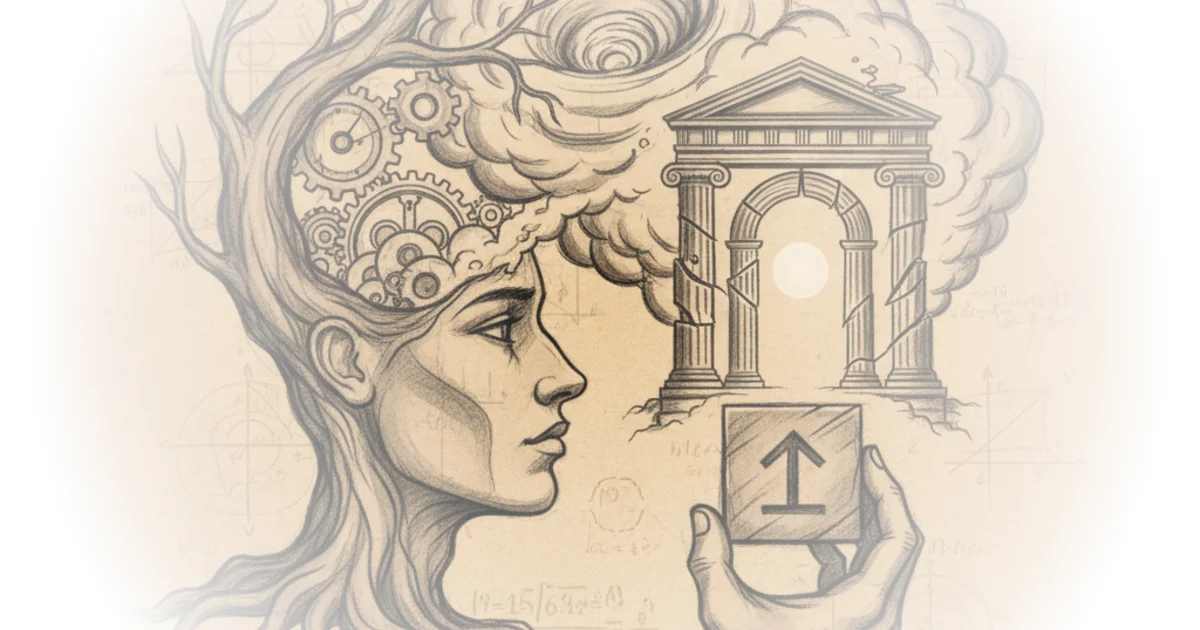
William's Identity Crisis
The core of this piece centers on William James's struggle to find himself. As Cecil tells it, James was "always quite gifted, very very successful education-wise, knew he was smart, knew he had skills, didn't have any idea what to do with them." This is almost painful to read — here's someone brilliant, watching his younger brother Henry launch a literary career while he's still searching.
What makes this compelling is the specificity: at 22, Henry starts publishing reviews. By 26, he's "more or less an independent person, living off the earnings and royalties, becoming quite the reputation in Europe." Meanwhile, William — older by 18 months — has no clear path. His first instinct? Become a painter. Then he goes to Harvard, wanders around, eventually decides to study medicine "for the cash almost purely."
The Father's Unconventional教育
Cecil's description of James's father is remarkable. He "did not believe in public education. He thought the public schools just ruined your mind." But here's the twist: "it's not clear he knew what he believed in." So the man keeps hiring tutors, firing them, taking over education himself, realizing it wasn't working, then shipping the family to Europe. This goes on for years. The father puts young William in German schools, then French schools, then pulls him out again. It's chaos — but as Cecil notes, "this gave him a big help so that he corresponded and wrote and visited a lot in later life with French and German philosophers."
The Brazilian Adventure
One of the most vivid sections involves James's trip to Brazil under the guise of becoming a naturalist. Cecil describes it as "Brazil is terra incognito. I mean no one knows what's going on there." James goes with a professor who wanted to prove Darwin wrong by showing fish in different parts of the Amazon were radically different from fish in other areas — suggesting they couldn't have evolved from a common ancestor.
What happens? James gets "attacked by all kinds of tropical diseases and bugs and snakes," but mostly he finds it "horribly boring." Hour after hour, day after day: "you go out in a canoe, you row up the Amazon, you collect fish, you salt the fish, you put them in a barrel." He realizes naturalist life isn't for him. This is the kind of detail that makes the piece memorable — the specific, the concrete, the mundane reality behind grand intellectual ambitions.
The Principles of Psychology
Cecil argues that James's "Principles of Psychology" — 1100 pages combining philosophy, psychology and physiology — is "one of the great works in the English language." He emphasizes everything James writes comes from "the standpoint of an empiricist which is to say I need evidence."
This empirical commitment shapes his entire philosophical stance. Cecil writes that James "makes him an enemy of all idealism. He did not like idealists at all in any way, shape, or form." His argument against Christian original sin? "You cannot experience original sin. You can't test for original sin. There's no, it's an ideal." Against Buddhist first noble truth (the world is suffering)? Anyone who's lived in the world has had moments of joy — "the human experience suggests that there is a mix of joy and sorrow."
If you don't feel it, it's probably he doesn't think it's probably true.
This is James's core test: return to experience, return to what you can actually feel. No evidence? No belief. It's radical, and Cecil presents it well.
Counterpoints
Critics might note that characterizing William James as "our only philosopher" simplifies a rich tradition — figures like John Dewey, Cornel West, or contemporary thinkers certainly merit consideration. Others might push back on the implication that medicine was merely a financial fallback; James's interest in physiology was genuine and shaped his psychological work.
Bottom Line
Wes Cecil's piece succeeds through specificity: the knife-wielding family dinners, the Amazon fish-salting tedium, the father's educational chaos. These details transform what could be a standard biography into something vivid and strange. The strongest argument — that James represents America's philosophical contribution — is bold but well-supported by his influence on European thinkers. Where it weakens? It occasionally leans too hard into the "only philosopher" framing without exploring who came after him. For busy readers, this piece offers genuine insight into why one man matters so profoundly to American intellectual history.