Joey Politano delivers a stinging economic autopsy of a trade war that treats America's closest allies as enemies, arguing that the current administration's tariff chaos is not just bad policy, but a fundamental betrayal of the "friend-shoring" strategy the US spent a decade building. The piece is notable for its granular data on how North American supply chains have already reoriented to replace China, only to be targeted by the very nation they were meant to serve.
The Asymmetry of Pain
Politano opens by dismantling the idea that a trade war is a level playing field. The core of the argument rests on a stark disparity in economic exposure: while the US is a massive, diversified economy, its neighbors are tethered to American demand. "US trade with Canada and Mexico is 7% the size of its GDP, meanwhile Mexico and Canada's trade with the US is 45% and 34% the size of their GDP, respectively," Politano writes, illustrating why the shockwaves will be catastrophic for the north. This framing is effective because it moves the conversation from political posturing to hard arithmetic; the administration may view these tariffs as leverage, but the data suggests they are a weapon of mass economic destruction for the neighbors.
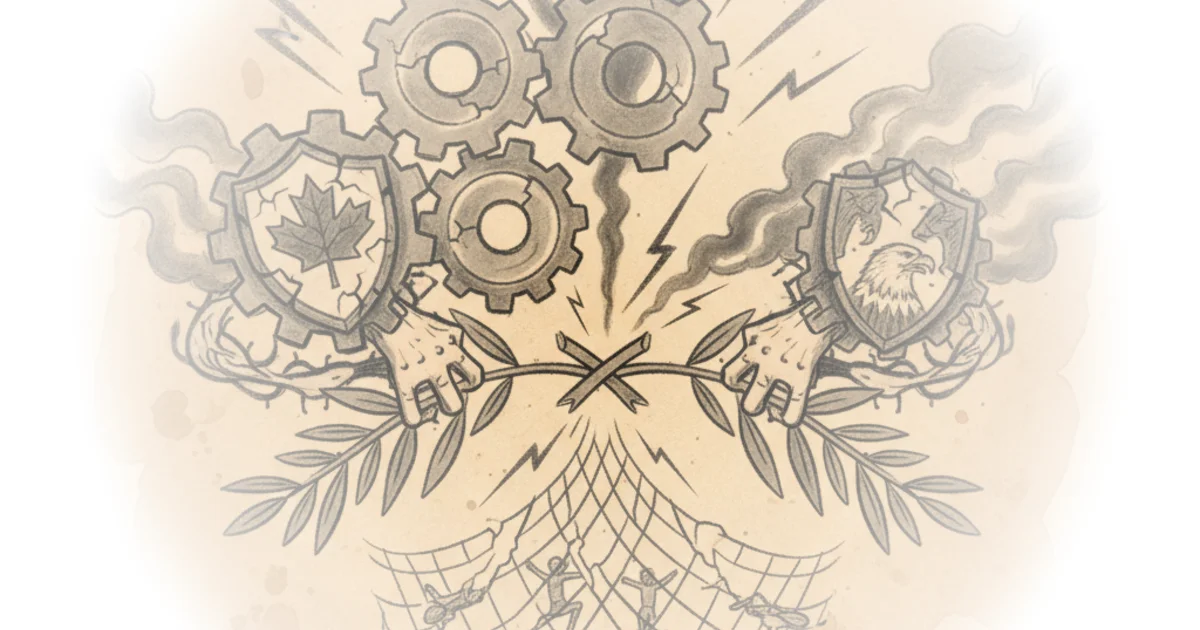
The author highlights the irony that these nations spent years aligning their industrial policies with Washington's goals. "When Trump's first-term trade war against China erupted, it was factories in Mexico or Canada that worked to replace many Chinese-made goods," Politano notes. This historical context is crucial. It reframes the current tariffs not as a correction of unfair trade, but as a punishment for successful cooperation. Critics might argue that the US needs to assert dominance regardless of past alliances, but the piece effectively counters that this approach undermines the very "strategic decoupling" from China the administration claims to prioritize.
The cruel irony is that both countries have spent the last decade-plus trying to make themselves the centerpiece of US "friend-shoring" efforts to move supply chains towards its close allies.
The Human and Industrial Cost
The commentary then shifts to the specific sectors facing the brunt of this policy, moving beyond abstract GDP figures to the real-world impact on workers. Politano points out that the threat of tariffs is already freezing investment and hiring. "In surveys done by the Bank of Canada, Canucks are already bracing for the impact of trade tensions—consumers are trying to save more and spend less, businesses are cutting hiring and slowing investment," the author writes. This evidence of immediate economic paralysis before a single new tariff is fully implemented is a powerful indictment of the administration's erratic strategy.
The analysis is particularly sharp regarding Mexico, where the manufacturing sector is the lifeblood of the economy. "Roughly one-in-six Mexican workers are in manufacturing, compared to one-in-eleven Canadian workers or one-in-twelve American workers," Politano explains. The piece details how the northern border states, which have seen rapid growth, are now the most vulnerable. This focus on regional devastation adds a necessary layer of human consequence to the macroeconomic data. The argument that these tariffs will disproportionately hurt American workers through supply chain disruption is bolstered by the fact that "the large majority of those imports likely just need to fill out paperwork to become USMCA-compliant," yet the uncertainty itself is the damage.
The Collapse of Strategy
Perhaps the most damning section of the piece is the critique of the administration's lack of a coherent negotiating strategy. Politano observes that the demands are shifting and often contradictory, ranging from immigration to defense spending. "Vanishingly few of these demands are even internally consistent—basically no fentanyl comes through the northern border, Mexico is already cooperating with America's more restrictive immigration policies," the author writes. This exposes the tariffs as a tool of coercion rather than a genuine attempt to solve specific policy problems.
The piece argues that this approach is self-defeating. "Expanding the trade war like this is going to amplify its costs, undermine US growth, increase business uncertainty, hurt US allies, and make the administration's stated goal of "strategic decoupling" from China even more difficult," Politano asserts. The logic here is sound: you cannot decouple from a rival while simultaneously dismantling the alliances required to build a resilient, alternative supply chain. The administration's view that "on-shoring or nothing" is the only path ignores the reality that modern manufacturing is inherently global and interdependent.
If Trump continues down this path, it'll be the death knell of the "friend-shoring" era and an incredibly costly move for economies throughout North America.
Bottom Line
Politano's strongest contribution is the demonstration that the administration is actively dismantling the industrial architecture it claimed to be building, turning allies into economic enemies with reckless abandon. The argument's greatest vulnerability is its reliance on the assumption that the administration will not eventually pivot; if the political will to maintain these tariffs hardens, the economic forecasts may become the least of the region's worries. The reader must watch whether the "token concessions" mentioned are merely pauses or the beginning of a permanent shift toward economic isolationism.