Jordan Schneider's latest analysis cuts through the pageantry of the recent Beijing summit to expose a stark diplomatic asymmetry: while the American delegation appeared mesmerized by Chinese architecture, the administration inadvertently handed Beijing a massive propaganda victory. This piece is notable not for recounting the events of the trip, but for dissecting the psychological and strategic cost of an American president seeking validation from a strategic rival. In an era defined by technological decoupling and geopolitical friction, the argument that "prestige on the cheap" was traded for empty optics demands immediate attention from anyone tracking the long-term trajectory of US-China relations.
The Cost of Pageantry
Schneider frames the summit not as a breakthrough, but as a reversal of decades of diplomatic protocol where the host nation typically maintains a stoic, business-like demeanor. The core of the argument rests on the visual evidence of the American team's reaction to the Chinese state's grandeur. "The visuals and optics are probably some of the biggest takeaways from this meeting," notes Jon Czin, a former CIA and NSC official, who observes that the US delegation failed to "maintain your guard for the purpose of those visuals." Schneider amplifies this by highlighting specific moments of awe, such as Marco Rubio's reaction to the Great Hall of the People and the President's fascination with the trees at Zhongnanhai.
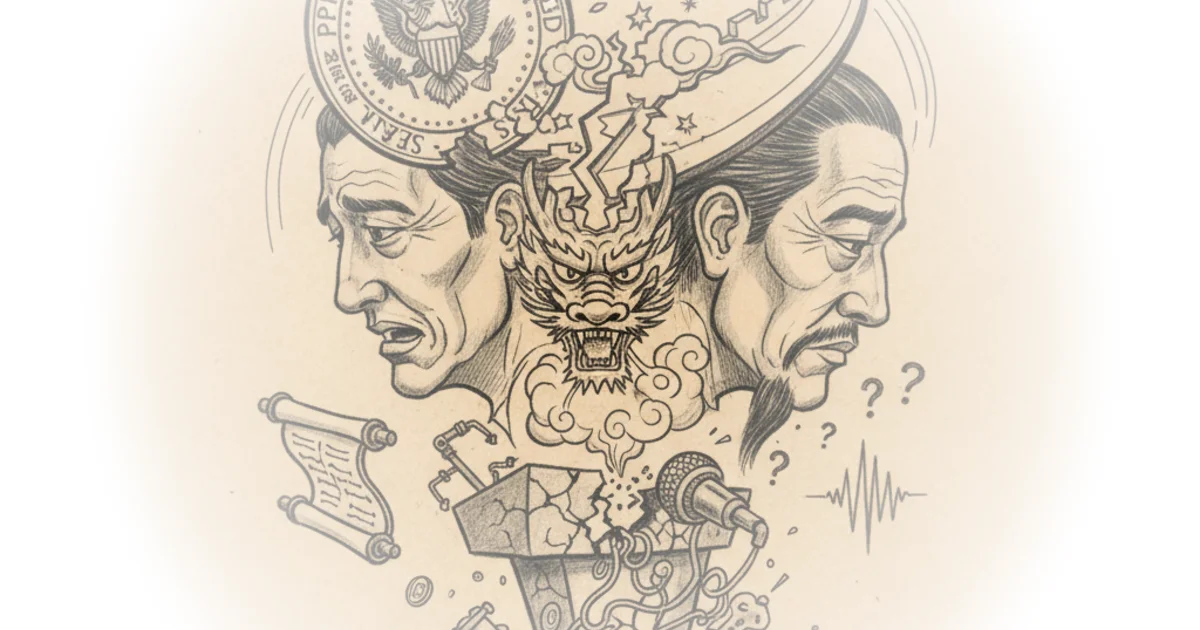
This framing is effective because it shifts the focus from policy outcomes to the subtle, often overlooked mechanics of power projection. The author argues that by appearing "blown away," the American side handed China a psychological win that no trade concession could match. "It felt like the way the Americans comported themselves in China over these two days — you could not be giving more prestige points to China," Schneider writes, citing historian Sergey Radchenko. The comparison to the 1972 Nixon visit is particularly sharp; while Nixon's handshake with Zhou Enlai was a calculated step toward opening a new era, the current administration's gawking feels less like strategic opening and more like submission. Critics might argue that appreciating a host's culture is a sign of respect rather than weakness, but Schneider rightly points out that in high-stakes diplomacy, the appearance of being overwhelmed undermines the negotiating position.
To see Trump do that, almost kowtow to the Chinese communist leadership — not quite physically, obviously, but expressing this level of admiration — I think this was over the top, frankly.
The Illusion of the G2
The commentary then pivots to the structural impossibility of the "G2" concept—the idea that the US and China could jointly run the world. Schneider draws a parallel to the failed détente between Nixon and Brezhnev, suggesting that personal chemistry cannot override deep-seated strategic competition. "The G2 that never was: Why Trump's dream of running the world with Xi echoes Nixon and Brezhnev's failed détente, and how strategic competition makes genuine cooperation impossible regardless of personal chemistry," the author summarizes. This is a crucial correction to the narrative that a friendly handshake can reset a fractured relationship.
The piece highlights a fundamental mismatch in diplomatic styles. While the American side operates on the belief that charisma and back-slapping can seal deals, the Chinese leadership remains "very unsentimental about personal relationships." Schneider notes that Xi Jinping's approach is methodical, viewing the summit through a lens of long-term calculation rather than immediate rapport. The administration's hope for a "deal" is described as a "mismatched" approach that ignores the reality of the rivalry. "You can kiss up to Xi Jinping all you want — it won't change this reality. Or you can swear at him all you want — it still won't change this reality, except maybe making it worse," Radchenko observes in the text. This sobering assessment suggests that the administration's focus on personal validation is a distraction from the hard work of managing a complex strategic rivalry.
The Business Flex That Backfired
Perhaps the most incisive part of Schneider's analysis concerns the composition of the US delegation. The inclusion of tech titans like Tim Cook, Elon Musk, and Jensen Huang was intended as a display of American industrial might. However, the author argues this backfired, signaling a desire to do business rather than to compete. "My suspicion — or my intuition — is that what the Trump administration was trying to do by bringing Tim Cook, Elon Musk, and Jensen Huang is to do it as a flex... But the way it ended up looking from Beijing's perspective is that you are here to do business rather than to compete with us," Schneider writes. This reframing turns a perceived strength into a strategic vulnerability.
The analysis suggests that the administration's strategy of bringing a "gaggle of executives" signaled a return to the pre-2016 era of engagement, which is now obsolete. "If you close your eyes or squint a little, that could be a statement straight out of the George W. Bush or Clinton administration, not from the period of strategic competition," the text notes. This is a vital point for busy readers to grasp: the signals sent by the delegation's composition may have undermined the administration's stated goal of containing China's technological rise. Instead of projecting strength, the visit appeared to be a plea for market access. The author also touches on the AI factor, noting that the US brought a safety dialogue proposal as its "only real leverage in an otherwise empty summit," highlighting the lack of substantive policy achievements.
The entire Trump team actually needs that validation just as much as China wants to provide that validation to stroke the visitor's ego.
The Midterm Calculation
The piece concludes with a chilling assessment of the timing. Schneider suggests that Xi Jinping is playing a long game, withholding concessions until the US midterm elections in 2026. "The midterm calculation: How Xi is withholding concessions until September 2026, betting that Trump will need wins most desperately right before the elections," the author explains. This reframes the summit not as a moment of cooperation, but as a tactical pause where China is methodically building domestic capacity while the US struggles with its own industrial policy. The argument posits that the administration's need for a quick win plays directly into Beijing's hands.
Bottom Line
Schneider's strongest contribution is the dismantling of the "prestige on the cheap" narrative, revealing how the administration's desire for validation weakened its diplomatic standing without yielding tangible policy gains. The piece's biggest vulnerability lies in its reliance on the assumption that a more stoic American posture would have yielded better results, a claim that remains unproven in a system where the Chinese leadership is equally calculating. The reader should watch for whether the administration can pivot from seeking personal validation to executing a coherent strategy of strategic competition before the 2026 elections, or if the current trajectory of empty optics will continue to define the relationship.