Peter Gelderloos transforms the mundane act of driving into a profound meditation on survival, memory, and the architecture of American labor. Rather than offering a standard memoir of employment, the piece argues that the physical act of steering a vehicle has served as the author's primary mechanism for navigating trauma, family fracture, and the crushing weight of late-stage capitalism.
The Paradox of Retrospection
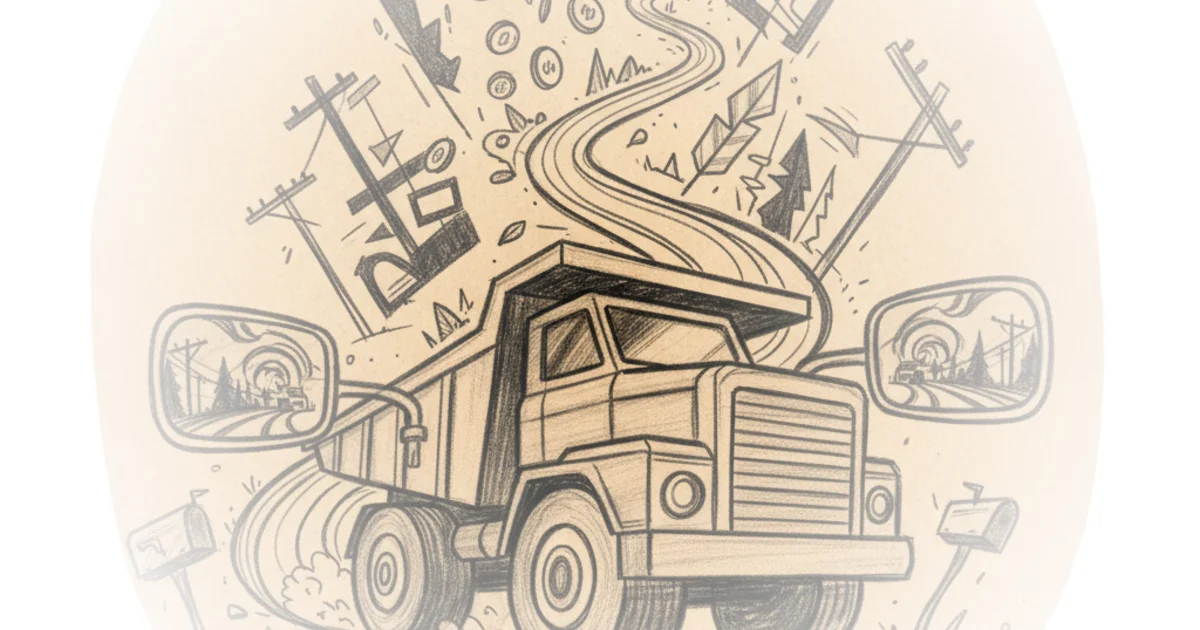
Gelderloos opens with a striking observation about the mechanics of operating heavy machinery, suggesting that safety requires a backward gaze. "Driving a dump truck for my landscaping job this spring was a special kind of heaven," he writes, describing the paradox of keeping a massive vehicle safe by "constantly looking behind you at the path you've already taken, until retrospection becomes second nature." This framing is immediate and visceral; it turns the act of driving into a metaphor for processing a chaotic past. The author posits that one keeps themselves safe in the "onrushing future" only by mastering the rearview mirror.
This connection between the road and personal history is not merely poetic; it is structural. Gelderloos details how driving served as a refuge during a childhood marked by domestic violence and eventual family disintegration. He recalls his father's long, nocturnal drives as a form of "caretaking," the only way the man knew how to protect his children. "He didn't need to [use a map]," Gelderloos notes, "Once he'd driven somewhere, years later he could find his way again. (He lost that ability once he started using a navigation app.)" The loss of this intuitive skill mirrors the loss of the father's emotional capacity, a subtle but powerful critique of how technology can erode human connection and competence.
You keep from mauling any mailboxes in front of you by watching how close you just came to obstacles and the painted side lines behind you.
The narrative then shifts to the author's youth, where the car became a vessel for a subculture of punk rock and shared poverty. Gelderloos describes cramping twelve people into a small Mazda, a scene that highlights both the desperation and the communal solidarity of that era. "I'd listen happily to the raucous conversation that filtered through from the back seat and privately sing along to all our youthful anthems coming through loud and clear on the speakers," he recalls. Here, the vehicle is a sanctuary from "suburban depression," a mobile space where a generation of outsiders found a voice.
The Economics of the Wheel
As the author moves into adulthood, the romanticism of the road collides with the harsh realities of the gig economy and the decline of professional labor. Gelderloos recounts his time as a taxi driver in Harrisonburg, a job he took after dropping out of college and leaving prison. He paints a picture of a profession stripped of dignity by corporate restructuring. "All in cash, cause in those days only an asshole would pay for a cab with a credit card… before this scab culture screwed over professional drivers by switching to surveillance apps like Uber," he writes. This is a sharp indictment of the platform economy, which replaced human dispatchers with algorithms and turned independent contractors into disposable units.
The physical toll of this labor is described with unflinching honesty. The author drove retired police cruisers with "special engines with amazing pickup," but the comfort was nonexistent. "The old ones had really shitty seats, which gave me back problems and worsened the fistula I'd gotten from that punishment work shift in prison," Gelderloos states. This detail grounds the political critique in bodily reality; the exploitation of the worker is not abstract, it is written in the pain of the driver's spine.
Critics might argue that the author's focus on the "scab culture" of Uber overlooks the broader structural shifts in the service economy that predate app-based ride-sharing. However, the specific mechanism of surveillance and the loss of cash-based autonomy remains a potent example of how technology has been weaponized against labor.
The Politics of the Holiday
The piece culminates in a historical excavation of Labor Day, reframing the holiday not as a celebration of work, but as a political maneuver to suppress international solidarity. Gelderloos explains that International Workers' Day on May 1 was born from the 1886 general strike and the Haymarket Square bombing, events where anarchists and reformers fought for the eight-hour day. "To insulate the nation from the plague of international solidarity, the US government declared a holiday not to celebrate workers but to celebrate work, and they put it in September," he argues.
This historical context is crucial for understanding the author's cynicism toward the current celebration of labor. He notes that the US and the Netherlands are among the few nations that do not observe May Day, suggesting a deliberate isolation from the global working-class movement. "Most other governments declared it a holiday after years of strikes and riots because a great way to prevent a strike is to give people the day off," Gelderloos observes. The argument suggests that the American holiday is a tool of pacification, designed to celebrate the act of laboring rather than the rights of the laborer.
To insulate the nation from the plague of international solidarity, the US government declared a holiday not to celebrate workers but to celebrate work.
The author also touches on the irony of how communist states co-opted the holiday, turning it into a military celebration rather than a workers' one. "The beacons of the working class, Russia and China, have turned May Day into a holiday celebrating the military," he writes, noting the regime's use of the military to crush the very revolutions that birthed the holiday. This dual critique of American and authoritarian responses to labor unrest adds depth to the piece, showing that the co-opting of worker movements is a global phenomenon.
Bottom Line
Gelderloos's most compelling contribution is his ability to weave the physical sensation of driving with the political economy of labor, creating a narrative where the rearview mirror becomes a tool for historical analysis. The piece's greatest vulnerability lies in its reliance on personal anecdote to make broad structural claims, which may feel insufficient to readers seeking hard data on labor statistics. However, the emotional resonance of the argument—linking the driver's pain to the worker's struggle—offers a necessary human counterpoint to dry policy debates.
You keep yourself safe in the onrushing future by constantly looking behind you at the path you've already taken, until retrospection becomes second nature.