This piece drops a bombshell that redefines the current geopolitical landscape: the sudden, violent death of Iran's Supreme Leader, Ayatollah Ali Khamenei, within the first 24 hours of a massive US-Israeli offensive. Good Times Bad Times does not merely report the strike; it dissects the terrifying assumption behind the operation—that a vacuum of power will instantly trigger a popular uprising, a gamble that history suggests is fraught with peril.
The Strategy of Decapitation
The author frames the conflict not as a traditional war of attrition but as a calculated attempt at regime collapse through targeted elimination. Good Times Bad Times writes, "Israel has concentrated on decapitation strikes, targeted operations aimed at eliminating the Islamic Republic's political and military leadership." This approach mirrors historical precedents like Operation Praying Mantis, where the US sought to degrade Iranian naval power, but the scale here is unprecedented. The commentary notes that on the first day alone, the Israel Defense Forces claimed more than 40 senior officers were killed, including the defense minister and the commander of the Revolutionary Guard.
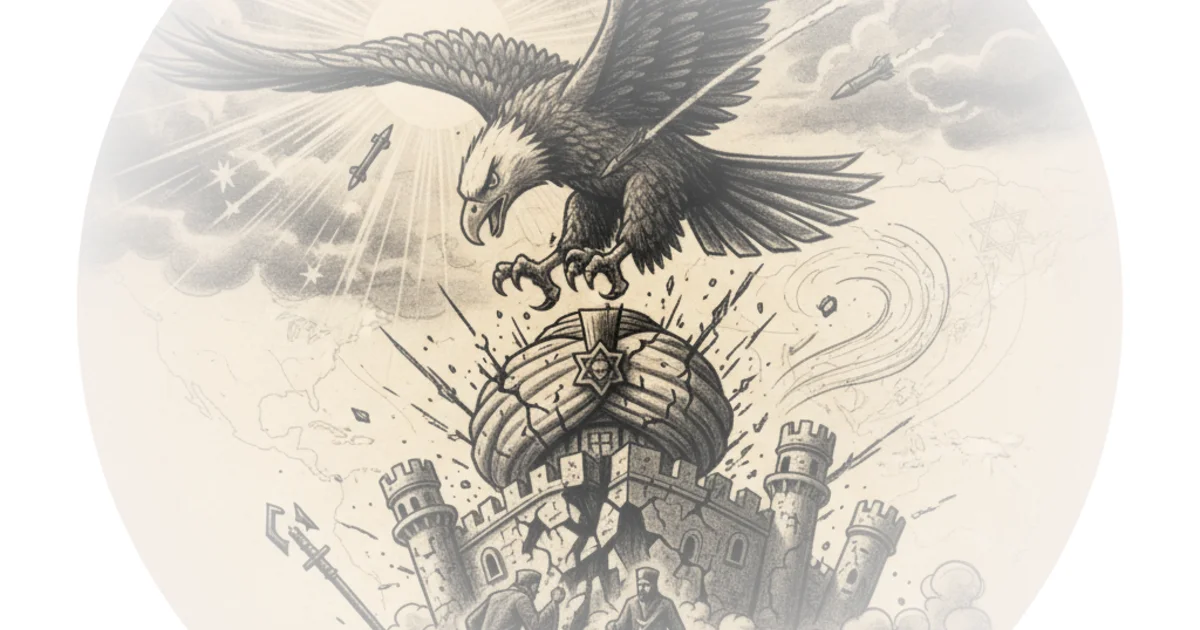
The core of the argument rests on the belief that removing the head will cause the body to collapse. As the author puts it, "The American Israeli strategy is built on a central assumption that once Iran's leadership is eliminated, a political vacuum will emerge and that ordinary Iranians will step into that vacuum, rise up, and bring down what remains of the regime." This logic is compelling on paper but dangerously optimistic. The author acknowledges the fragility of this bet, noting that previous appeals for the Iranian public to rise up have yielded no tangible results. Critics might argue that in a highly centralized theocracy, the removal of the supreme leader often triggers a consolidation of power by hardliners rather than a democratic awakening.
The plan bets on a political vacuum, but history suggests it may only create a power struggle that hardens the regime's resolve.
The Scale of the Assault
The sheer magnitude of the military operation is described with chilling precision. Good Times Bad Times details how "Israel has deployed around 200 fighter jets, making this the largest combat air operation in the country's history," supported by American B-2 strategic bombers and carrier strike groups. The targets were not just military but existential: the presidential compound, intelligence headquarters, and the nuclear complex in Isfahan. The author highlights the strategic importance of Kark Island, the hub for 90% of Iran's oil exports, noting that while it was struck, the full extent of the damage remains unclear.
This section effectively conveys the overwhelming force applied by the executive branch and its allies. The author writes, "The United States has committed a comparable number of aircraft supported by B2 strategic bombers and Tomahawk cruise missiles." This demonstrates a shift from the limited strikes of the past to a campaign designed to cripple state functionality. However, the commentary also points out a critical vulnerability in the US-Israeli calculus: the assumption that a short war is possible. The author reminds readers that "the sense of the Middle East have misled more than one US president," referencing the long, grinding conflicts in Afghanistan and Iraq that began with similar hopes for quick victories.
The Retaliation and Regional Spiral
The piece pivots sharply to the Iranian response, which was immediate and devastating. Good Times Bad Times notes that "Roughly one hour after the opening wave of USIsraeli strikes, Iranian forces launched retaliatory operations," utilizing a recently loosened rules of engagement that allowed field commanders to act autonomously. This decentralization of command, a lesson learned from previous conflicts, allowed Tehran to launch "True Promise 4" with remarkable speed, firing hundreds of ballistic missiles and drones at US bases across the Gulf and at civilian infrastructure in the UAE.
The author argues that this retaliation is a strategic gamble. "Tehran is betting that the Gulf monarchies facing direct economic and security risks will pressure Donald Trump to end the war." This is a sophisticated reading of the regional dynamics, suggesting that Iran is trying to fracture the coalition by hitting the economic interests of the Gulf states. The text highlights the disruption to global oil flows, noting that a tanker attack in the Strait of Hormuz has already caused significant shipping delays. "Tensions are also rising in the straight of Hormuz through which roughly 20% of global oil consumption flows," the author warns, underscoring the global economic stakes of this regional conflict.
The Succession Crisis
Perhaps the most critical analysis in the piece concerns the power vacuum left by the Supreme Leader's death. Good Times Bad Times explains that under Iran's constitution, a three-member interim council is set to manage the state until the Assembly of Experts selects a new leader. However, the author suggests this process will be chaotic. "Convening all 88 members could prove difficult, and gathering them in a single location would carry obvious security risks," the text observes.
The commentary identifies Ali Larijani, the Secretary of the Supreme National Security Council, as the likely power broker during this transition. "If true, that would make Larijani not just a caretaker figure, but the central power broker in Iran at the moment of war, uncertainty, and potential internal fragmentation." This insight moves beyond the surface-level news of the death to the intricate mechanics of Iranian succession. The author rightly notes that a dynastic succession is unlikely, as the Islamic Republic was founded in opposition to hereditary rule, yet the uncertainty remains a massive variable in the coming weeks.
The greatest uncertainty in the current confrontation may not be the military balance, but the chaotic succession that follows the death of the Supreme Leader.
Bottom Line
Good Times Bad Times delivers a stark assessment: the US and Israel have executed a bold, high-risk strategy of decapitation that has succeeded in killing the top leadership but failed to guarantee the collapse of the regime. The piece's strongest argument is the warning that the assumption of a popular uprising is a dangerous gamble that ignores the resilience of the Iranian state and the potential for a prolonged, spiraling conflict. The biggest vulnerability in the current situation is the unknown nature of the succession process, which could either fracture the regime or unite it in a desperate, unified defense against foreign intervention.