Alberto Romero identifies a cultural fracture that feels both inevitable and deeply ironic: the moment we stop reading not because texts are too long, but because we suspect they were never written by a human at all. He coins the term "AI;DR" ("AI; didn't read") to describe a new form of skepticism that has replaced the old "too long; didn't read," arguing that we are witnessing a collapse of the social contract between writer and reader. This is not merely a complaint about spam; it is a diagnosis of a "post-literate" society where the very concept of authorship is dissolving into a collective, algorithmic echo chamber.
The Collapse of Intent
Romero frames the shift from "too long" to "AI; didn't read" as a fundamental change in how we value human effort. He writes, "The semicolon, which in the original separated cause from effect—the more you write, the less I read—now separates the machine's output from your refusal to dignify it with your attention." This distinction is crucial. The old objection was about the reader's time; the new objection is about the writer's intent. As Romero puts it, "we've gone from 'I won't finish that' to 'no one started that.'" The former assumes personal responsibility for limitations, while the latter urges us to externalize that responsibility entirely.
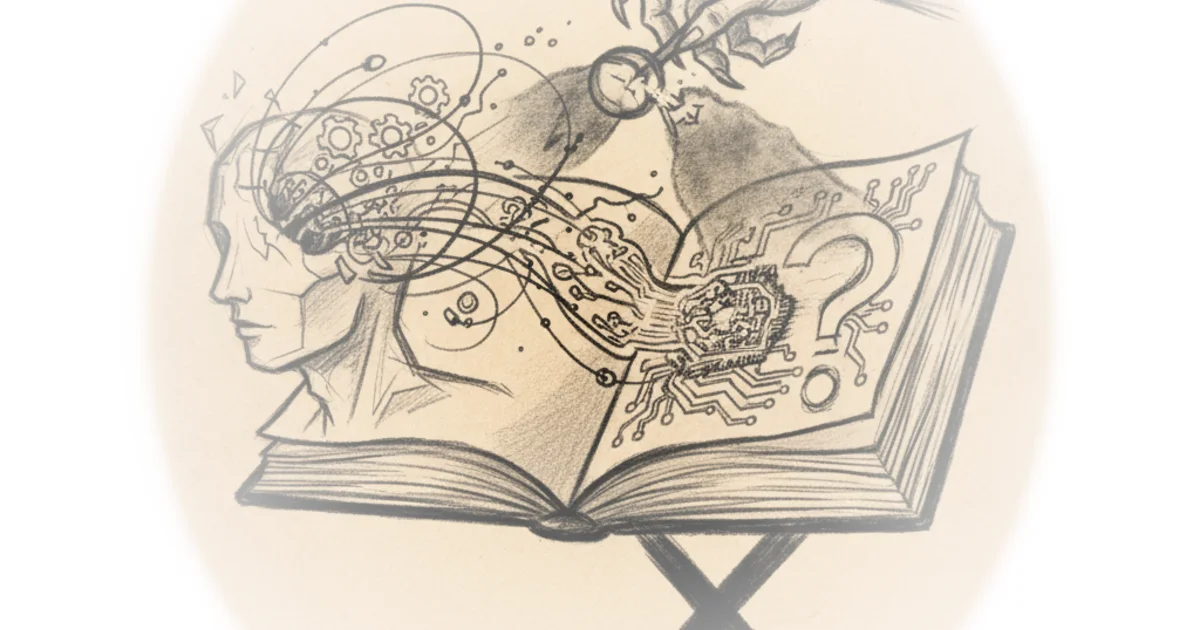
This observation lands with particular force because it highlights a paradox: the very tools designed to amplify human expression are creating a barrier to human connection. Romero suggests that the "AI;DR" instinct is "profoundly reasonable" because "slop is slop whether it's made of silicon or carbon." When a text lacks the friction of human struggle, it fails to honor the reader's time. He notes that the implicit social contract of reading requires that "I give you my thought, you give me your time," and when one party automates their end of the deal, the other feels "rightfully swindled."
"The effective impact of AI;DR, as well-intended as its true purpose might be, is in line with the times: we're not short on excuses to read less."
Critics might argue that this purism ignores the reality that human writing has always been flawed, lazy, or derivative. Romero anticipates this by acknowledging that Dostoevsky wrote quickly and Nietzsche edited little, yet their work remains revered because it carries a specific, undeniable intent. The issue isn't speed; it's the absence of a soul behind the words.
The Failure of the Boycott
Romero then pivots to a more pessimistic analysis: the "AI;DR" movement is destined to fail as a form of protest. He argues that refusing to read AI-generated text assumes a level of consumer power that simply doesn't exist in the current media ecosystem. He writes, "The logic of AI;DR assumes that refusing to read AI-generated text will... discourage its production the way refusing to buy fast fashion... is supposed to discourage sweatshops." But in 2026, he contends, "fast is... synonymous with good."
The evidence for this failure is stark. Romero points to research showing that major outlets like The New York Times and The Wall Street Journal are flagged for likely AI use, yet their readership remains unaffected. "The seas will dry up, the mountains will flatten, and the skies will burn before the grifter on duty stops generating text with AI because 'faster does not mean better,'" he writes. This is a sobering reminder that market forces, not moral outrage, drive the adoption of these tools. The ability to detect AI is also inversely correlated with the ability to use it, meaning those most likely to boycott are the least equipped to identify the target.
The Return of the Anonymous Bard
Despite the failure of the boycott, Romero finds a strange, almost poetic historical parallel in the rise of AI writing. He suggests we are not entering a new era of alienation, but returning to a pre-modern state of "collective selfless authorship." He writes, "ChatGPT can be characterized as the amalgamation of everything that has ever been written online. In that sense, every AI word doesn't have zero authors but infinitely many." This reframes the AI text not as a lie, but as a new form of oral tradition, where anonymous bards sang songs that built the cultural scaffolding of modernity.
This connection to the past offers a way to navigate the "post-literacy" period without despair. Romero suggests that if we cannot distinguish the "soul leaking itself through the spaces between words" from the "cooling water that leaks off of the GPU racks," we must accept that the "Author" was perhaps never truly alive in the way we imagined. He invokes the spirit of Petrarch, who loved Cicero because he could read nothing else, urging a "new Renaissance" built on a refusal of the slop and a return to the classics.
"To a degree you'd rather not know, I am AI. And you did read this. For the sake of irony-maxxing, I made this with AI."
The piece's most devastating blow comes in its final twist. Romero reveals that the very essay critiquing the inability to distinguish human from machine was itself generated by AI. This is not a gimmick; it is the ultimate proof of his thesis. He writes, "There is no AI;DR: it won't work, for you remain unable to tell apart a soul leaking itself through the spaces between words, from the cooling water that leaks off of the GPU racks." The reader, by continuing to engage, has already validated the new reality.
Bottom Line
Romero's argument is strongest in its diagnosis of the broken "writer-reader contract" and its devastatingly accurate prediction that consumer boycotts will fail against the economic imperative of speed. Its greatest vulnerability is the romanticization of "collective authorship," which may offer little comfort to those seeking genuine human connection in a flooded information landscape. The reader should watch for how institutions begin to formalize the distinction between human and machine content, as the current era of "undisclosed AI" is likely the calm before a regulatory storm.