The Moai of Easter Island weren't just carved from volcanic rock — they were moved across miles of rugged terrain using ingenuity that still astounds modern engineers.
That's the claim at the heart of this conversation with Carl Lipo, an anthropologist at Binghamton University who has spent decades studying Rapa Nui. His research, conducted alongside Terry Hunt at the University of Arizona, produced something unexpected: a viral video demonstrating how the ancient Rapa Nui people moved these massive statues using surprisingly simple techniques.
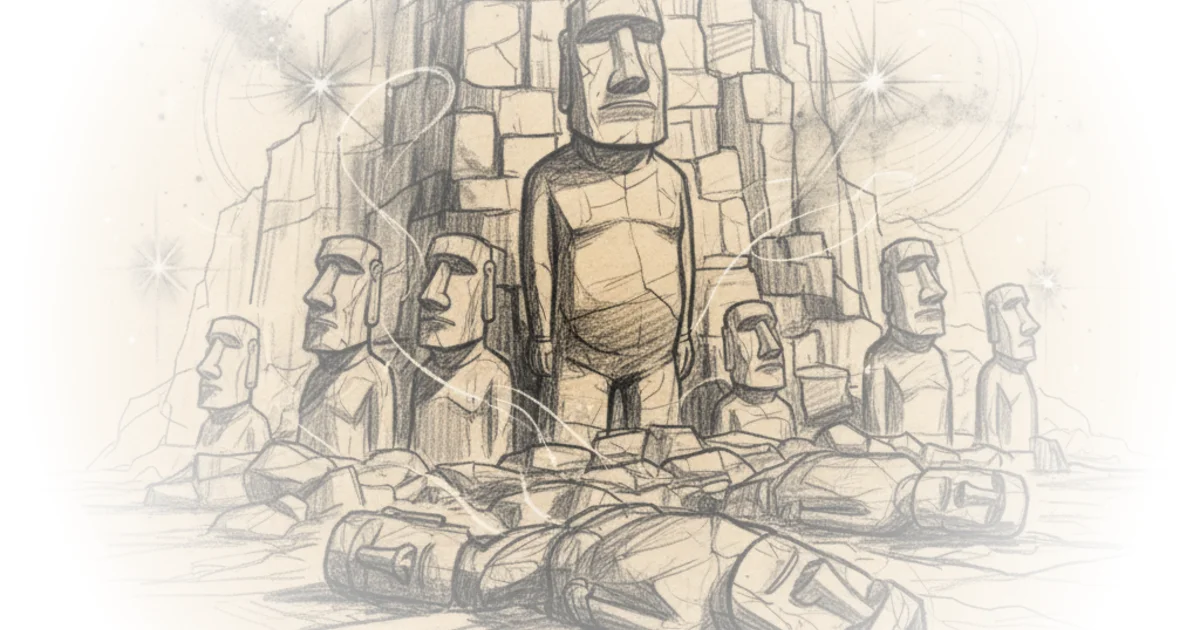
The island itself is almost impossibly remote. Imagine being stranded 2,000 miles from any other landmass in the Pacific Ocean — your entire universe contained in a triangle of volcanic rock barely six by ten miles wide. That's Rapa Nui. And somehow,without wheels, without cranes, without any machinery we would recognize — the people who lived there carved and moved nearly a thousand statues across that small island.
They moved them using ropes on both sides, with a rope in back, enabling something completely immovable to dance down the road.
The quarry where this happened is called Rano Roraku — a volcanic crater formed around 200,000 to 400,000 years ago. The stone there is unique: ash that blew through shallow underwater craters, creating glass-like crystals that fused together into a compressed material perfect for carving. Lipo's team used modern drone technology to create a 3D map of the quarry — collecting over 22,000 photos and stitching them together with computer software to achieve centimeter-level precision.
The Numbers That Stump Everyone
Here's what surprises people most: when asked how many moai exist on Rapa Nui, most guess maybe 100. The reality is nearly a thousand statues. About 600 were moved out of the quarry to platforms around the island. Around 400 remain in the quarry itself, still at various stages of construction.
That changes everything about how we understand this achievement. One moai would be remarkable. A hundred would be astonishing. Nearly a thousand — moved miles across terrain using nothing but rope and human muscle — represents something far beyond what most people imagine.
Critics might note that some researchers debate whether the quarry was primarily for statue-carving or also agricultural production. The soil there has higher potassium and minerals, making it slightly more productive than other areas on the island. But Lipo doesn't see evidence of extensive gardens surrounding the quarry — suggesting this was fundamentally a workshop for statues, not farming.
Why This Matters
Rapa Nui represents something specific: proof that human ingenuity exists in every era, in every place, under constraints we can barely imagine. These people lived in absolute isolation — their universe was one small island — and still accomplished things we struggle to replicate today with all our technology.
They arrived around the 13th century AD and maintained their society until European arrival in the 1722. Their descendants still live on the island, speaking Rapanoui. It's not an abandoned ruin — it's a living community that built something extraordinary.
The 2012 Nova special where Lipo's team actually moved a replica statue — about 4.3 tons — became viral proof of what they achieved. Watching that video feels like watching a stone giant dance down the road. The ingenuity required to do this with limited resources is, in Lipo's words, "mind-blowing."
Bottom Line
The strongest part of this piece is its concrete demonstration: seeing the replica move transforms abstract wonder into something visceral. The vulnerability is that we still don't fully understand why they moved them — what motivated that massive effort remains debated. But the fact that they did it at all, on one of the most isolated islands in the world, with nothing but rope and determination, tells us something important about human capability. We tend to assume our ancestors were less capable than us. Rapa Nui suggests we should be more humble.