Jeffrey Kaplan attempts the impossible: compressing a semester's worth of ethical philosophy into a single video lecture, and in doing so, exposes a startling fragility in the moral codes we take for granted. The piece is not merely a summary of ancient thinkers; it is a dismantling of the assumption that our current sense of right and wrong is natural or inevitable. For the busy professional navigating a complex world, Kaplan's rapid-fire synthesis offers a rare clarity on why we feel the way we do about power, humility, and justice.
The Origins of Our Moral Code
Kaplan begins by challenging the very foundation of conventional morality, tracing it back to a historical shift rather than divine truth. He introduces Friedrich Nietzsche's provocative claim that our modern emphasis on humility and kindness is not a universal good, but a specific historical outcome. "Nietzsche's answer to the question why be moral is don't don't be moral because morality is for losers," Kaplan writes, capturing the philosopher's abrasive tone. This framing is jarring but necessary; it forces the reader to confront the possibility that our deepest moral instincts are actually the result of a power struggle among the powerless.
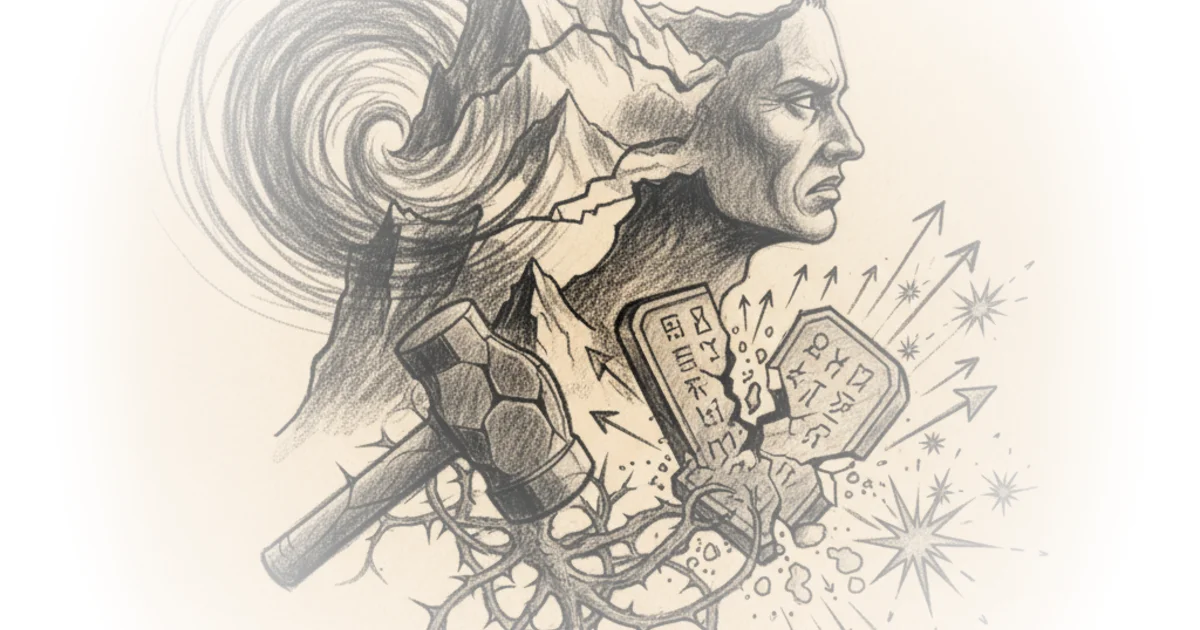
The author explains that Nietzsche distinguishes between "true objective moral facts" and "conventional morality," which is simply the accepted code of a society. Kaplan notes that Nietzsche targets the "bourgeois middle class european christianized moral code," arguing that it elevates meekness over strength. "He's going to be criticizing the idea that people should be humble and that they should be kind and that institutions should be fair and just and democratic," Kaplan paraphrases. This is a bold move. By labeling this system a "slave revolt," Nietzsche suggests that our current ethics are a weapon used by the weak to constrain the strong. The argument holds weight because it explains why moral systems often feel like they are working against our natural instincts for self-assertion.
The word good originally just meant aristocratic or rich or powerful and the word bad had no inculpatory implication.
Kaplan illustrates this with etymology, showing how the word "bad" once simply meant "common" or "plain." The shift from "good vs. bad" to "good vs. evil" represents a fundamental change in how power is perceived. "This revolt wasn't a physical overthrowing of the dominating people... this was a sort of moral revolt or revolution," Kaplan explains. The insight here is that moral language can be a tool of social engineering. Critics might argue that Nietzsche's view is too cynical, ignoring the genuine human capacity for altruism that exists independent of power dynamics. Yet, Kaplan's presentation of the "priestly mode of valuation" forces a re-evaluation of why we value fairness so highly.
The Search for Objective Truth
Having destabilized conventional morality, Kaplan pivots to the question of whether any objective moral facts exist at all. He turns to David Hume, the Scottish Enlightenment philosopher who argued that morality is a matter of feeling, not fact. "Take any action allowed to be vicious willful murder for instance examine it in all lights and see if you can find that matter of fact or real existence which you call vice," Kaplan quotes. Hume's point is that when we observe a crime, we see the knife and the blood, but we never see the "vice" itself. The badness is a reaction within us, not a property of the object.
This argument is powerful because it aligns with a scientific worldview that demands empirical evidence. "Hume applies this principle which seems like a very rational one he applies it to morality and he gets the result that oh we don't need to believe in moral facts objective moral facts in order to explain anything that we experience," Kaplan summarizes. If morality cannot be observed, Hume suggests, it cannot be real. However, this leaves a vacuum: if morality is just a feeling, what stops us from acting on any impulse we choose?
To fill this gap, Kaplan introduces John Locke's attempt to ground morality in God. The argument is that since God created humans, humans are God's property, and we must not harm God's property. "This argument might be perfectly good like it might very well be that premise one is true premise two is true premise four is true," Kaplan admits. But then he delivers the knockout blow: the argument is circular. "You can't use an argument of this style in order to show where all objective moral facts come from in the first place," he writes. The premise that we "must not harm someone else's property" already assumes a moral fact exists. It cannot be used to prove the existence of moral facts.
You can't use god to explain the existence of all objective moral facts if in doing so you have to appeal to some prior existing putative objective moral fact.
Kaplan traces this logical trap back to Plato's Euthyphro, where Socrates asks whether the gods love good things because they are good, or if things are good because the gods love them. If the former, then goodness exists independently of the gods. If the latter, then morality is arbitrary. "If the reason that the gods love them is because they're already virtuous then then what made them virtuous in the first place," Kaplan asks. This dilemma remains one of the most persistent problems in philosophy. It suggests that even the strongest theological arguments for morality rely on a pre-existing moral framework they cannot explain.
The Unresolved Tension
The piece concludes by returning to Hume, acknowledging that while his argument against objective facts is strong, it is not without problems. Kaplan notes that if we accept Hume's view, we are left with a world where morality is purely subjective. "There's a problem though there's a problem with that argument so what i need to do at this point is i need to go back to david hume," he says, hinting at the complexity of the issue. The reader is left with a sense of intellectual vertigo: our conventional morals are a historical accident, our theological justifications are circular, and our empirical observations yield only feelings.
Critics might note that Kaplan's rapid-fire approach risks oversimplifying these nuanced debates, potentially leaving the reader with a sense of moral nihilism rather than a deeper understanding. However, the value of the piece lies in its ability to expose the cracks in the foundation of our ethical reasoning. It challenges the reader to think critically about the origins of their own values rather than accepting them as given.
The only thing that we experience that seems to be anywhere close to moral badness is just your own feelings your own feelings of disliking this action that you're witnessing.
Bottom Line
Jeffrey Kaplan's condensed lecture succeeds not by providing answers, but by rigorously dismantling the easy ones. The strongest part of the argument is its exposure of the circular logic in theological morality and the historical contingency of our current ethical norms. Its biggest vulnerability is the lack of a constructive alternative, leaving the reader with a deconstructed moral landscape but no clear path forward. The reader should watch for how this skepticism about objective morality influences future debates on justice and human rights, as the foundation of those discussions may be far shakier than assumed.