John Pistelli delivers a rare literary critique that refuses to separate aesthetic merit from political danger, arguing that the most provocative poetry of our moment may be born not from progressive urgency, but from reactionary despair. In a cultural landscape obsessed with purity tests, he suggests that the true scandal of a recent neoreactionary poem lies not in its author's ideology, but in how the work inadvertently dismantles the very authoritarian fantasies its writer intended to uphold.
The Architecture of Romantic Realism
Before tackling the political firestorm, Pistelli establishes a high bar for what literature should aspire to be, curating a list of "essential works" for a movement he calls "New Romanticism." He is not interested in the "slim slice-of-life novels written in benumbed translationese," but rather in fiction that offers a "total vision of life in all its sublime self-contradiction." To illustrate this, he points to Thomas Mann's The Magic Mountain, a novel he describes as a model that "combines thought and feeling, philosophy and sensuality, epic grandeur and cutting irony." This reference to Mann is particularly apt; just as Mann's 1924 masterpiece used a sanatorium to dissect the sickness of European civilization before the rise of fascism, Pistelli seeks a literature capable of diagnosing the current moment without succumbing to cynicism.
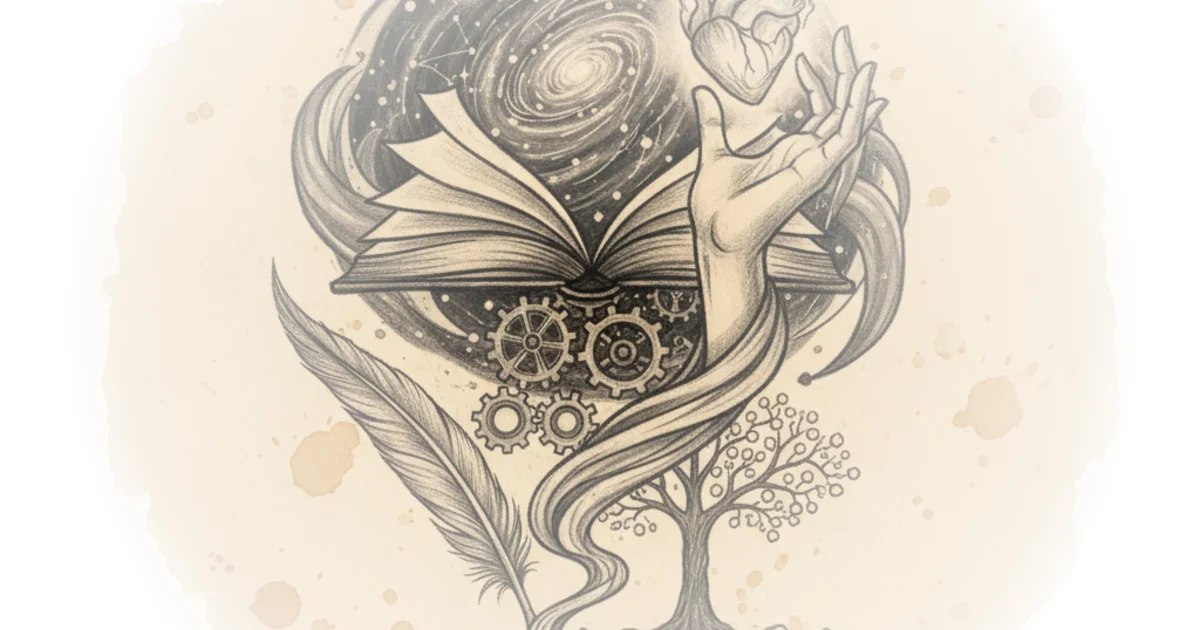
He expands this canon to include D.H. Lawrence, whose work teaches that "fastidiousness of style can be less potent than visionary rapture captured in language," and Iris Murdoch, whose The Sea, the Sea he calls a "latter-day Tempest." The argument here is that great fiction must be world-encompassing, capable of holding the light and the dark simultaneously. As he puts it, Roberto Bolaño's 2666 demonstrates a "stunningly unprogrammatic 'romantic anarchism,'" blending gravity with speed in a way that resists easy political categorization. This framing is effective because it shifts the reader's focus from the author's biography to the text's capacity to hold complexity, a necessary precursor to the difficult analysis that follows.
"With that in mind, I will first open up the question to anyone else who wants to answer it on behalf of 'New Romanticism' at large and second answer on my own behalf with five novels constellated around the 'Romantic Realist' aesthetic."
The Paradox of Reactionary Art
The piece pivots sharply to a contemporary controversy: the publication of a poem by Curtis Jarvin, a figure associated with the neoreactionary movement, in the literary journal Spectra. Pistelli acknowledges the immediate backlash from the literary left, who view platforming such figures as a moral failure. He notes the historical leftist position that "fascists will make better art than liberals" because they are politically serious, while liberals are "politically unserious." He quotes Terry Eagleton to underscore this tension: "The radical right finds conventional middle-class society supremely distasteful, and confronts it with a critique far more searching and fundamental, if also a good deal more wrong-headed, than anything a liberal realism can muster."
However, Pistelli challenges the notion that we must reject the art of the far right simply because of the artist's politics. He argues that to do so is to fall into a trap of "purification, itself the very nucleus of fascist desire." Instead, he suggests that the poem in question, an ode to the author's newborn son, functions as an unintentional critique of the author's own ideology. By comparing it to W.B. Yeats's "A Prayer for My Daughter," which wishes for a child to be insulated in a medieval hierarchy of "custom" and "ceremony," Pistelli highlights a crucial divergence. While Yeats seeks to impose the authority of the past on the future, Jarvin's poem, according to Pistelli, concedes that "time, embodied in the infant, is revolution."
The analysis deepens when Pistelli interprets the poem's imagery of the "clouded newborn eyes / Of our alien overlord." He argues that the threat to the father's worldview does not come from an external invader or immigrant, but from the "very own offspring." This is a devastating reading of the text, suggesting that the poem reveals the inevitable failure of the reactionary dream. As Pistelli writes, "The one who will burn your 'beautiful oak door'... is not an immigrant, not an interloper, not an invader, not a stranger, not an Other, but your very own offspring."
Critics might note that this interpretation relies heavily on reading the author's intent against the grain of their stated beliefs, a risky maneuver that could be seen as imposing a liberal narrative onto a reactionary text. Yet, Pistelli's defense is that art possesses an "irony" that transcends the author's control. He invokes the Marxist idea that "Irony...is the highest freedom that can be achieved in a world without God," suggesting that the poem's true power lies in its ability to betray the very politics it was meant to serve.
"To become a father at all, then, is not to become a sovereign patriarch, the lord of the manor, but rather to risk becoming that 'good man' Brecht's revolutionary, here recast as the mewling infant, will put up against the revolutionary wall and shoot someday soon."
The Inevitability of Division
Pistelli concludes by dismantling the foundational myth of the neoreactionary movement: the idea that the family and the nation are one, and that loyalty is absolute. He argues that the poem inadvertently proves that "politics, qua sublimated warfare, is when factions with dueling interests, and therefore no obligation to mutual loyalty, negotiate." The presence of a new generation, with its own distinct reality, ensures that the "primordial social unity" imagined by thinkers like Thomas Carlyle is a fantasy. The child, by virtue of being a new consciousness, is a revolutionary force.
He draws a parallel to the dialectical division found in the works of Marx and Freud, asserting that "revolution inheres in the structure of personal and political temporality." The poem, therefore, becomes a "political palinode," a recantation of the author's own views, even if the author does not realize it. Pistelli writes, "With this oedipal precept in mind... we could go so far as to read the poem as the poet's political palinode, his concession that his politics have never been anything other than a dying animal's compensatory fantasy."
This is a bold claim, one that suggests that the future is not something to be feared or controlled, but an inevitable force that will dismantle the rigid structures of the past. It is a reminder that the most powerful art often speaks truths that its creators cannot fully comprehend. As Pistelli notes, "Leftists should be sending thank-you cards to Spectra!" for publishing a work that so thoroughly undermines the ideology of the right from within.
"The alternative is a desire for purification, itself the very nucleus of fascist desire, as another canceled poet once told us."
Bottom Line
John Pistelli's commentary succeeds by refusing to let the political controversy overshadow the literary analysis, instead using the text to expose the internal contradictions of the ideology it represents. The strongest part of his argument is the reading of the newborn child as the ultimate agent of revolution, a concept that turns the reactionary fear of the future on its head. However, the piece's vulnerability lies in its assumption that irony is a sufficient defense against the real-world harm of reactionary politics; while art may betray its author, the ideas themselves remain dangerous in the hands of those who ignore the text's subversive conclusion. Readers should watch for how this tension between aesthetic irony and political consequence plays out in future cultural debates.