Paul Cooper doesn't just recount the history of a lost city; he dismantles the romantic myth of its discovery to reveal a civilization that never truly vanished, only transformed. While Western narratives often celebrate the moment European explorers stumbled upon Angkor, Cooper argues that the site was a living, breathing center of worship for centuries, challenging the very notion of what it means for a civilization to "fall." This is not a story of abandonment, but of a profound shift in power and belief that reshaped Southeast Asia.
The Myth of Discovery
Cooper immediately confronts the colonial lens through which Angkor has traditionally been viewed. He notes that when Portuguese missionary Antonio de Magdalena arrived in 1586, he was stunned by the scale of the ruins, describing a city "grander and more magnificent than anything they had ever seen back home in Europe." Yet, the local guides could not even name the place, referring to it simply as "the city," a word that eventually became "Angkor."
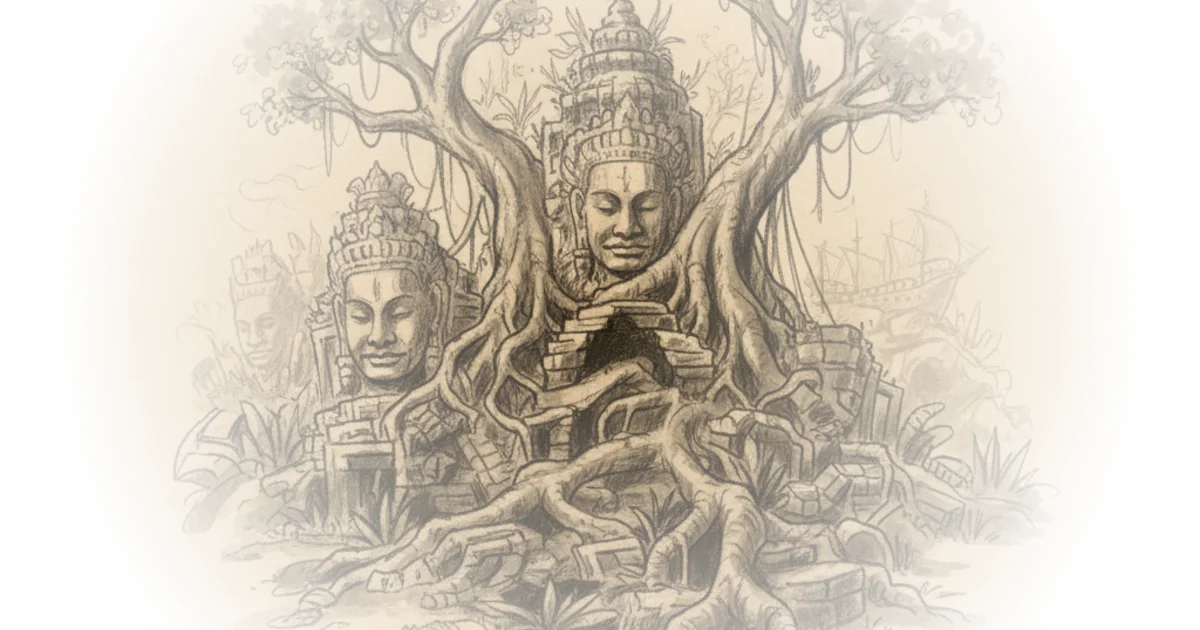
The author highlights a persistent European delusion: the inability to credit the local population with such architectural genius. "Virtually nobody in Europe gave credit to those people who had actually built these great temples and palaces," Cooper writes. Instead, they spun fantasies of Roman emperors or Alexander the Great as the architects. This framing is crucial because it exposes how the erasure of the Khmer people began long before the jungle reclaimed their stone. By attributing the ruins to outsiders, early observers effectively severed the living culture from its ancient roots.
"Stories of European explorers cutting their way through the jungle and stumbling on the ruins of lost cities have always been popular in the Western imagination."
Cooper's correction is vital. He points out that while the population may have shifted in the mid-15th century, "Angkor has never really been lost." Monks in tangerine robes continued to perform rituals among the crumbling shrines, and farmers worked the fields nearby. The site was not a ghost town waiting for discovery; it was a sacred landscape that had simply changed its function. This distinction reframes the narrative from one of tragedy to one of continuity.
The Rise of the God-King
The core of Cooper's argument lies in the political and spiritual innovation that birthed the empire. He traces the unification of the region to Jayavarman II, a "shadowy warrior" who, in 802, declared himself the first true king of a unified Cambodia. Cooper emphasizes that Jayavarman II was not just a conqueror but a revolutionary who needed a new legitimacy to unite fractured kingdoms.
To achieve this, he instituted the devaraja ritual, a ceremony that transformed a mortal ruler into a living deity. "He would crown himself something that had never before existed: the God-King of the Khmer," Cooper explains. This was not mere propaganda; it was a fundamental restructuring of society where the king became the axis of the cosmos. The capital city was designed to mirror Mount Meru, the home of the gods, with reservoirs representing the cosmic sea.
"The symbolic power of this ritual seemed to work: when the remaining kingdoms of the Khmer heard that a god-king had been crowned, their will to fight dissolved."
This move was brilliant but fragile. By tying the state's stability entirely to the divine status of the ruler, the empire made itself vulnerable to any disruption in that cosmic order. Critics might note that Cooper focuses heavily on the grandeur of the ritual without fully exploring the economic coercion required to sustain such massive construction projects. The "miraculous" unification likely involved significant force and resource extraction, not just spiritual awe. Nevertheless, Cooper effectively illustrates how a single ideological shift can reshape a region for centuries.
The Geography of Power
Cooper then pivots to the environmental context, arguing that the Khmer Empire's success was inextricably linked to the unique hydrology of the Mekong and Tonle Sap. He describes the lake as a natural wonder that reverses its flow during the monsoon, swelling from a shallow body of water into an "inland sea" ten times its normal depth.
This geographical feature was the engine of the empire's agricultural surplus. The ability to manage such massive water fluctuations allowed the Khmer to support a population density that was unprecedented for the time. "One in every thousand persons in the world lived in the city of Angkor" during its peak, Cooper notes. The city covered over 1,000 square kilometers, larger than modern New York City.
"The challenges that the Great Lake presented to ancient people were... the very source of their power."
However, this reliance on a complex hydraulic system also created a single point of failure. As Cooper hints, the very infrastructure that allowed the empire to thrive—massive embankments, canals, and reservoirs—required constant maintenance and a stable climate. When the monsoon patterns shifted or the system became too complex to manage, the foundation of the state began to crack. The narrative suggests that the collapse was not a sudden event but a gradual unraveling of a system pushed beyond its limits.
Bottom Line
Paul Cooper's analysis succeeds by stripping away the romantic veneer of "lost cities" to reveal a sophisticated, living civilization that adapted and evolved long after its political center shifted. His strongest argument is the reclamation of the Khmer people as the true architects of their history, countering centuries of Eurocentric erasure. However, the piece leaves the reader with a lingering question: if the hydraulic system was the key to their rise, was its eventual failure inevitable? The lesson for the modern world is clear: even the most magnificent systems are only as strong as the environment and the social cohesion that sustain them.