The piece is a video transcript that needs adaptation into polished long-form journalism. Let me analyze the source and adapt it properly.
{A recent breakthrough in ancient DNA research has pinpointed when modern humans first interbred with Neanderthals — and it's rewriting the timeline of our ancestors' journey out of Africa.
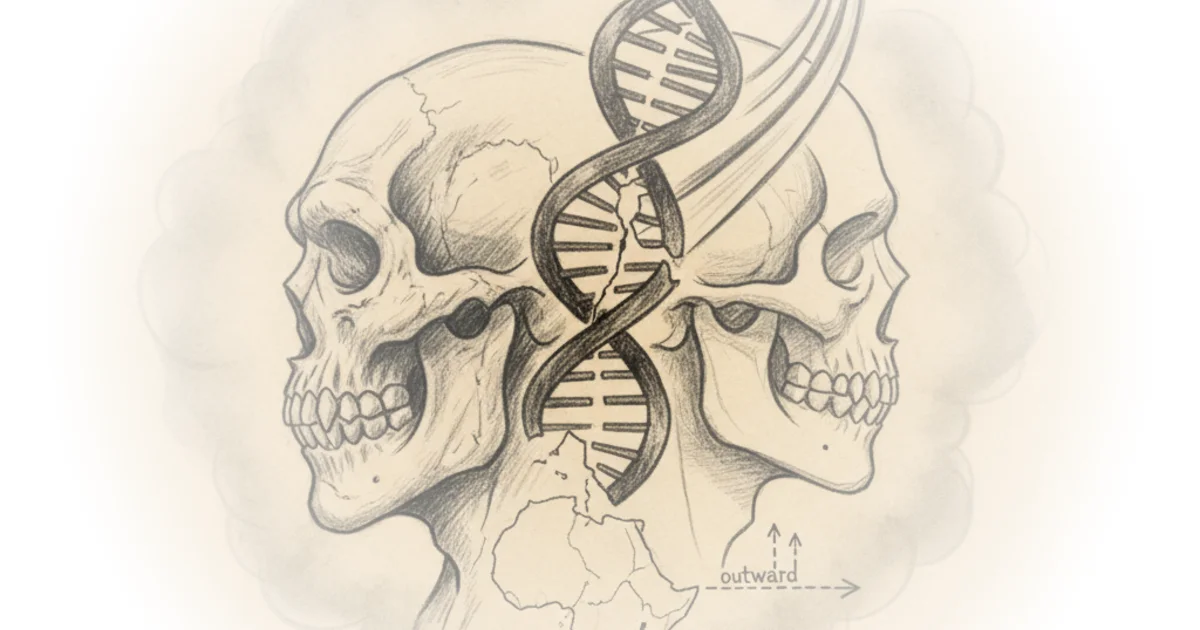
Two groundbreaking studies have converged on roughly 47,000 years ago as the date when our ancestors mixed genes with their Neanderthal cousins. This timing isn't just a number — it effectively sets a ceiling for when modern humans must have left Africa.
The Convergence Problem
Here's what's sparked such debate among geneticists and archaeologists: while genetic evidence shows Neanderthal interbreeding getting younger, archaeological finds of Homo sapiens outside Africa are getting older. Both phenomena are intimately connected to the pivotal "Out of Africa" event — the single migration that gave rise to all non-African populations today.
The evidence is remarkably consistent across multiple genetic lines. Africa harbors the greatest genetic diversity on Earth. In 1987, Mark Stone and colleagues published research on mitochondrial DNA genomes showing that Africa's population contains all the diversity present outside it. The same pattern appears in Y-chromosome data. When researchers examine nuclear genomes worldwide, diversity decreases as distance from Africa increases — a clear signal that our species originated there.
All non-African populations descend from this single migration roughly 60,000 years ago, and they all picked up Neanderthal DNA from the same interbreeding event.
The Breakthrough Papers
Two recent studies brought this debate into sharp focus. Leonardo Yaxi and colleagues published "Neandertal ancestry through time: insights from genomes of ancient and present day humans." Alles Sumezal's team released "Earliest modern human genome constrains timing of Neanderal admixture." Both papers reached remarkably similar conclusions using entirely different methodologies.
The first study, led by Arv (likely a mispronunciation of the author's name), sequenced the oldest modern human DNA to date. The specimens came from Zlatikun in Czech Republic — named for the "golden horse" ridge where a woman's remains were found in the 1950s. Though the individual couldn't be radiocarbon dated due to collagen contamination from animal glue used during preservation, genetic analysis showed she was older than 45,000 years.
The second study examined samples from Ranis in Germany — a site beneath a medieval castle that looks like something from a fairytale. Thirteen specimens belonged to six individuals excavated there. The best-preserved specimen, dubbed Ranis 13, yielded roughly 40% of the genome coverage — extraordinary for an Ice Age remains.
Family Connections Across Time
Both Zlatikun and Ranis date to approximately 45,000 years ago. The date estimates overlap so closely they likely lived within a few hundred years of each other. But the most striking finding came from genetic analysis: two individuals at Ranis were related to the Zlatikun woman at five or six degrees — distant cousins, perhaps grandmother and grandchild.
A mother-daughter pair was also discovered at Ranis. The emotional weight of finding family connections among ancient dead is real — these weren't just strangers dying side by side.
How Genetic Dating Works
The methodology relies on meiosis — the process where parental chromosomes shuffle during sperm and egg production. When modern humans interbred with Neanderthals, offspring inherited one set of chromosomes from each species. During subsequent meiosis, those chromosomes exchanged pieces, breaking down into smaller segments over thousands of generations.
Think of it like cutting a pizza: each generation divides the genetic material smaller. The slices get tiny, but the total amount remains constant. Neanderthal DNA hasn't increased — we simply can't interbreed with Neanderthals anymore. However, some Neanderthal genes have been selected against and removed from modern populations over time.
The result is remarkably consistent: roughly 2% of every non-African person's genome comes from Neanderthals. That percentage reflects the single event around 47,000 years ago — one group left Africa, met Neanderthals in the south, then diversified.
Critics might note that multiple "Out of Africa" migrations likely occurred over two million years of hominin evolution. The genetic evidence points to a primary event around 60,000 years ago, but earlier and later movements certainly happened. Some researchers argue the cave DNA evidence remains subject to contamination concerns that could shift dates further.
Bottom Line
The convergence of two independent studies on Neanderthal interbreeding at roughly 47,000 years ago is significant because it creates a "ceiling" for our ancestors' migration out of Africa. All non-African populations — from Aboriginal Australians to European Sami — descend from this single event and share ancestry from the same group of Neanderthals. The weakest point is that genetic evidence alone can't fully resolve the archaeological timeline, but together they tell a compelling story about when modern humans became truly modern.