Joeri Schasfoort cuts through the noise of panic-driven headlines to reveal a counterintuitive truth: the current hiring freeze isn't a simple story of robots stealing jobs, but a complex collision of artificial intelligence, geopolitical chaos, and a post-pandemic hangover. While social media screams that AI has rendered entry-level work obsolete, Schasfoort marshals payroll data and policy indices to show a far more nuanced, and arguably more dangerous, reality for job seekers. This is essential listening for anyone trying to navigate a market where the rules seem to have changed overnight.
The AI Illusion
The prevailing narrative suggests that artificial intelligence is indiscriminately wiping out the workforce, but Schasfoort challenges this with granular evidence. He notes that while AI adoption is indeed historic—"AI is the most rapidly adopted technology in human history"—its impact on employment is highly specific rather than universal. The author writes, "Early career software developers who tended to support older coders by doing simple tasks rapidly disappeared from companies after the launch of Chat GPT." This distinction is crucial; the technology isn't replacing the workforce, it is pruning the bottom of the ladder.
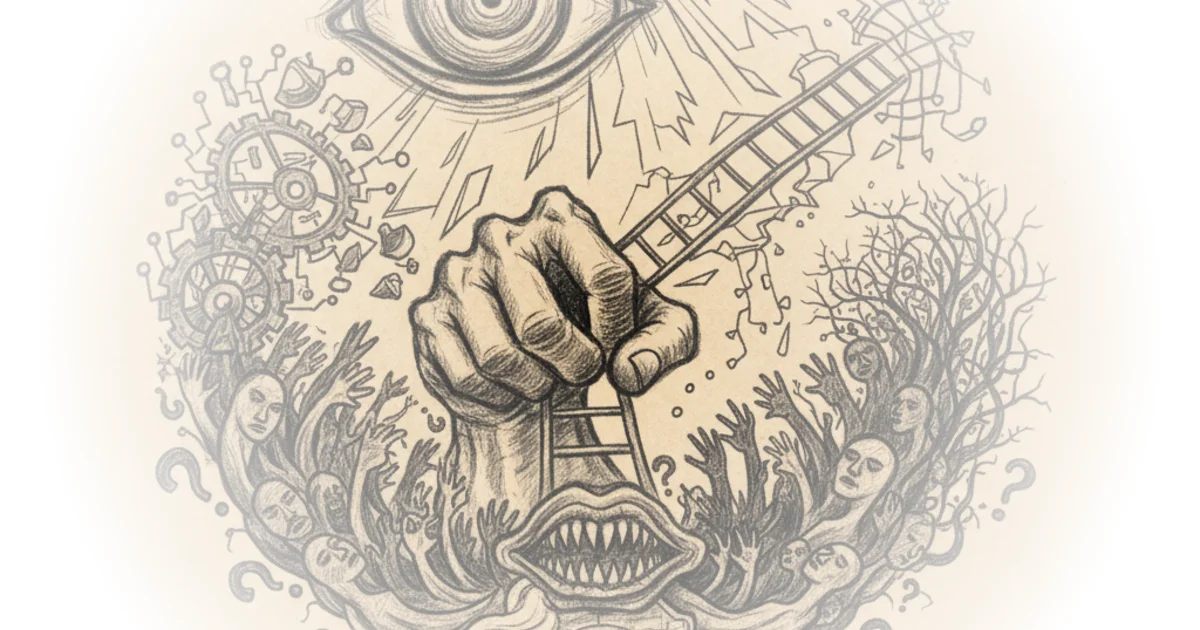
Schasfoort reinforces this by citing studies on freelance markets where text-based and image-generation models caused a sharp decline in jobs for writers and designers, but left other sectors untouched. He argues, "AI is absolutely impacting jobs, but only in certain sectors. And in these sectors, it's the young, less experienced people that are indeed hurt more than their more experienced colleagues." This framing is effective because it shifts the blame from a vague technological apocalypse to a specific structural shift in how companies build teams. Critics might note that this data only captures the early stages of AI integration, and the long-term displacement could be far more widespread than current payroll snapshots suggest.
"Just because businesses are using AI, that by itself does not mean that it's costing jobs. After all, companies could be using AI to replace people. But they could also be using it to make existing workers more productive."
The author's analysis of the "printing press" analogy is particularly sharp. He reminds us that while the printing press decimated scribes, it created entirely new industries. However, he admits a sobering gap in the current data: "I couldn't find any good research on this [comparing jobs lost to jobs gained]." This honesty about the limits of current economic modeling strengthens his credibility, even as he bets that "on average it's also costing more jobs than it is creating" in the short term for specific fields.
The Policy Paralysis
If AI explains the drop in entry-level roles, Schasfoort argues it cannot explain the broad stagnation in hiring across the board. He pivots to a second, more volatile factor: policy uncertainty driven by political instability. He points to the erratic nature of trade wars, noting, "Trump's proposed tariffs have been going up and down like crazy over the year." This volatility forces a freeze in business activity. As he puts it, "When governments swing between aggressive and unpredictable policies, affected businesses freeze. Firms delay hiring, postpone investments, and wait to see what rules they'll be operating under next."
The evidence here is compelling, linking the surge in the policy uncertainty index directly to a rise in long-term unemployment and the specific struggles of Black workers, who historically are the "first to be laid off and the last to be rehired." Schasfoort writes, "Former economics Nobel Prize winner Paul Krugman argues that Trump's wildly erratic policies are in fact creating huge uncertainty which is deterring many companies from hiring workers." This connection between macro-politics and the micro-decision of a hiring manager is a vital insight often missed in daily news cycles.
However, the author identifies a significant flaw in this theory: the timing. "If we look at the falling hiring trend over a couple of years, it just doesn't match up. Jobs are decreasing ever since 2022 and uncertainty only really became extreme in 2025." This admission prevents the argument from becoming a convenient political scapegoat, forcing the reader to look at deeper, more persistent economic forces.
The Great Unwinding
The final piece of the puzzle requires zooming out decades, not just years. Schasfoort argues that we are witnessing the "unwinding of the co economy," a period where unemployment was artificially and exceptionally low. He observes, "Unemployment was really exceptionally low right before and after co. This was the period of the great resignation where jobs were so available that people were able to leave abusive bosses and underpaid jobs and move to better paid positions." The current market is not a crisis, he suggests, but a correction back to historical norms.
By drawing a line through decades of data for the US, UK, and Germany, he shows that current unemployment rates are often "well under or maybe in the case of the UK near to its long-term historical average." This perspective is a necessary antidote to the doom-scrolling of the modern job market. It suggests that the difficulty in finding a job is partly a return to reality after an anomaly, rather than a permanent new normal.
"Unemployment comes and goes in cycles. And the second is that unemployment was really exceptionally low right before and after co."
Bottom Line
Schasfoort's strongest contribution is his refusal to accept a single-cause explanation for a multi-faceted crisis, effectively dismantling the simplistic "AI took my job" narrative with data on policy uncertainty and historical cycles. His biggest vulnerability lies in the data gaps regarding job creation versus destruction, leaving the long-term trajectory of AI's impact slightly ambiguous. Readers should watch for how quickly the policy uncertainty resolves, as that variable could trigger a hiring surge faster than any technological adaptation.