The most surprising claim: Kafka diagnosed something we're still living through today — rational systems that start with good intentions but eventually become self-justifying traps that flatten what it means to be human.
Drawing on Adorno's interpretation of Kafka reveals how these systems work, why they fail, and what they reveal about modern life.
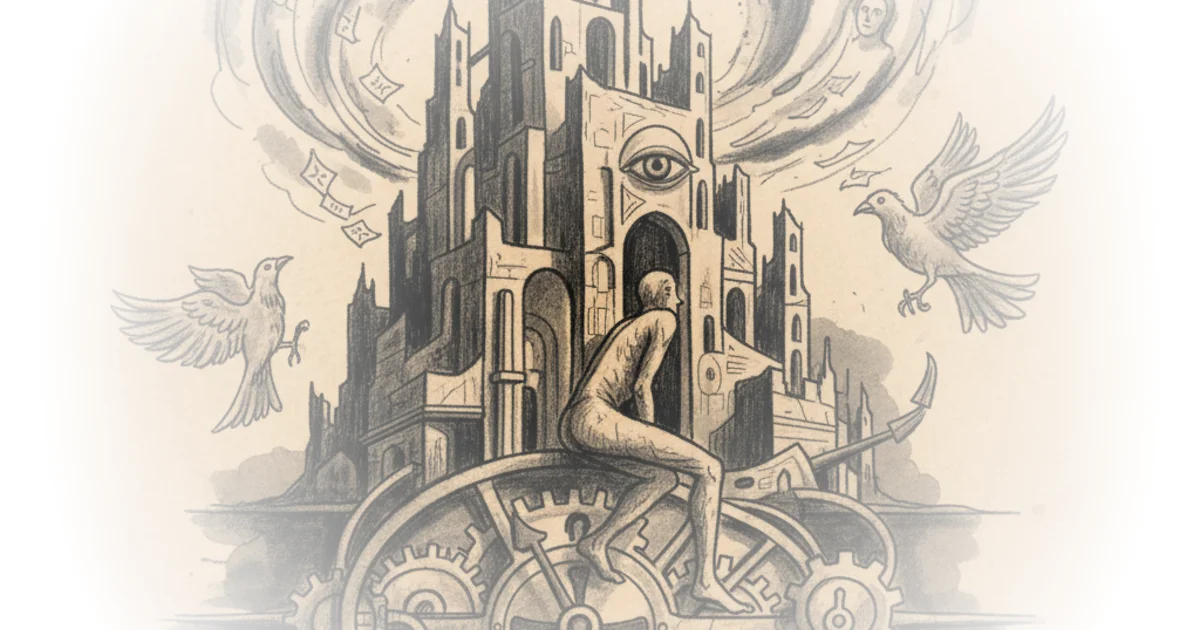
The Allegory Problem
Theodor Adorno argued that reading Kafka as a simple allegory misses something crucial about his work. When George Orwell wrote Animal Farm, readers could decode the characters — pig equals Stalin, horse equals proletariat, sheep represents the masses — and then put the book down. The meaning was extracted, the puzzle solved.
Kafka's work doesn't work this way. There's no single meaning to decode. No one-to-one mapping between his fictional world and our own. Instead, Adorno saw Kafka's writing as hermetic: a self-contained universe that operates by its own logic. This isn't metaphor. It's something more unsettling — a general structure of domination that applies to almost any rationalized system in modern life.
The Arc of Rational Systems
Adorno identified what he called repressive reason: when rationality is used to over-coordinate human existence, it produces predictable results. First comes the well-intentioned beginning. Someone experiences injustice or chaos. Smart people create rules and procedures to prevent it from happening again. This feels rational. Simplifying reality down feels good.
But then something happens. Rules layer onto rules. Protocols multiply. And eventually this system accomplishes three things: people feel guilty even when they're not doing anything wrong; they become alienated from the original purpose that started everything; and they experience a flattening of what it means to be a full person living through it.
Joseph K in The Trial exemplifies this. He's dragged through rational procedures until he doesn't know what he's being accused of, disoriented, alienated, guilty without understanding his crime. This isn't metaphor to Adorno — it's literal description of what happens when rational systems drift from their origins.
How It Happens Everywhere
The pattern repeats at every scale. Government agencies start with good intentions and become self-justifying machines. Politicians begin with noble causes and layer protocol upon protocol until they barely resemble who they started out as. Workplaces, schools, romantic relationships — all accumulate rational layers that drift from their origins.
Even personal life follows this arc. A diet starts wanting to feel better. Then rational protocols pile up — trackers, calorie counting, numbers on scales. Eventually the experience gets reduced to numbers and the original goal vanishes.
Social media began as spaces where people gathered. Now metrics govern behavior. Compliance with rational protocols drives posting toward fear and rage bait. The original purpose disappears beneath layers of self-justifying rules.
Adorno called this the "soothing facade" of repressive reason. Kafka's characters passively go along with their systems — silent, compliant — and this exposes just how ridiculous the compliance has become. His stories are a demolition of that facade.
Counterargument
Some readers might argue that reducing all social problems to rational system failure oversimplifies complex issues. Human suffering involves far more than bureaucratic drift — power dynamics, economic exploitation, cultural forces that no single framework fully captures. Adorno's analysis risks becoming deterministic, treating every rational system as inevitably drifting toward domination.
Bottom Line
Adorno's reading of Kafka remains powerful because the diagnosis hasn't changed. We are all living in Kafka's novels — trapped in systems that started with good intentions and now flatten our experience into numbers, metrics, and compliance. The strongest part of this argument is how it connects abstract philosophy to concrete modern life. Its vulnerability is the same as Kafka's work: no single solution offered, just diagnosis.