This piece offers a startlingly intimate autopsy of political violence, arguing that the true failure of secular anarchism was not tactical, but spiritual: it mistook the desire for power for the capacity to love. Anarchierkegaard suggests that when movements divorce their means from their ends, they do not liberate the world; they merely become enslaved to the very violence they sought to wield. For a reader navigating a world increasingly defined by performative outrage and ideological rigidity, this is a necessary warning about the seduction of "total war" against the status quo.
The Trap of the Will to Power
Anarchierkegaard begins by dissecting the historical failure of Italian secular anarchists, noting that their "plucky Romantic-idealists" believed they could simply seize power and then burn it away. The author argues this was a fundamental misunderstanding of human nature. "While those plucky Romantic-idealists genuinely believed that they could storm the walls of those humble Italian towns, seize the crown of power, and then burn the authority that they carried in an act of iconoclastic rage, the truth was that these ideas were only held aloft by their particular moral orientation." The core of the argument here is that the "will to power" is not a tool one can pick up and put down; it is a force that reshapes the user.
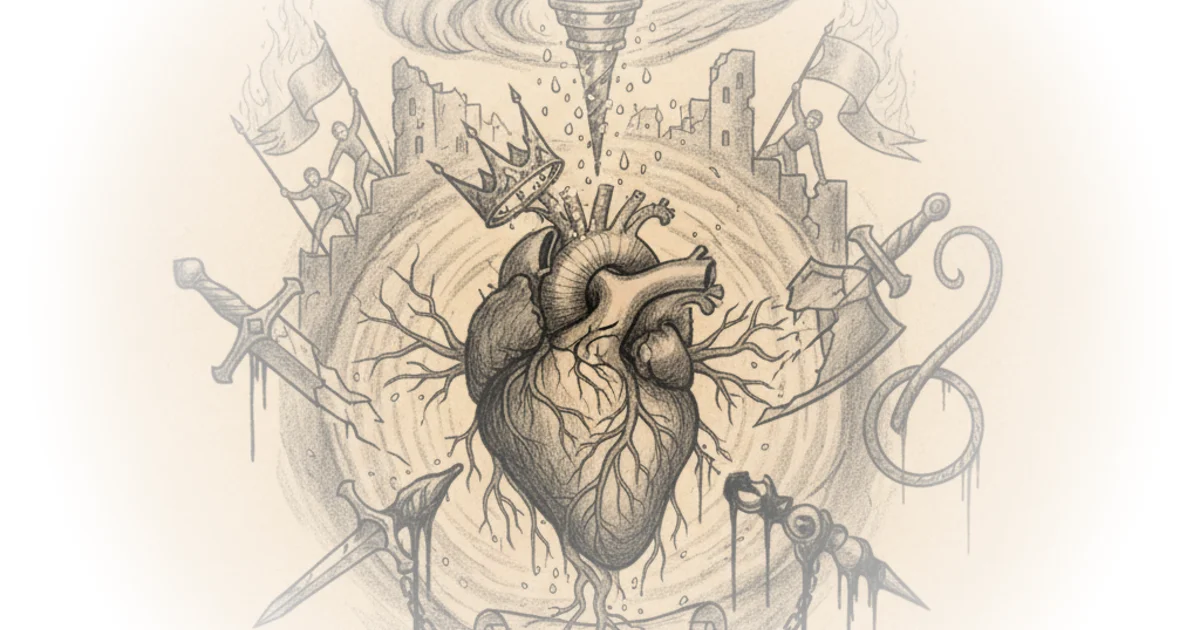
When the moral restraints that usually guide this will are removed, the movement collapses into what Anarchierkegaard calls an "aesthetic demand for power." The author writes, "When this will to power became frayed from the delicate moral life that held it in control, that steered the horses of power under the control of the delicate but determined reins in the hands of carriage driver, the secular anarchist movement descended into the aesthetic demand for power—and the complete collapse of the ability to hold oneself back." This is a profound observation on the psychology of revolution: the desire to destroy authority often mirrors the desire to possess it. The author effectively reframes terrorism not as a strategic error, but as a spiritual one.
"Having turned anarchy from a vision of the sublime creeping into politics... to a call for total against all, their terrorism for terrorism's sake was their own self-damnation."
Critics might argue that this theological framing ignores the material conditions that drive people to violence, suggesting that the "will to power" is a luxury of the privileged who do not face immediate starvation or oppression. However, Anarchierkegaard's point remains that the method of violence inevitably corrupts the goal, regardless of the initial justification.
The Unity of Means and Ends
The essay pivots to a corrective vision, contrasting the secular approach with Christian anarchism, specifically through the lens of Søren Kierkegaard. The author posits that true freedom requires a unity between what one does and who one becomes. "For the Christian anarchist, as a corrective to these secular wayfarers standing in the shadows of the quiet men of faith in times gone past, the unity of ends and means remained as an important corrective." Anarchierkegaard suggests that the secular model fails because it treats the world as a puzzle to be solved by the "correct" political mechanications, rather than a reality to be engaged with ethically.
The author draws heavily on Kierkegaard's concept of possession to illustrate this danger. "The world can be possessed only by its possessing me, and this in turn is the way it possesses the person who has won the world, since one who possesses the world in any other way possesses it as the accidental, as something that can be diminished, increased, lost, won, without his possession being essentially changed." This is the piece's most distinctive insight: the attempt to control the external world without first transforming the internal self leads to a "catastrophe of dispossession." The reader is forced to confront the idea that trying to force reality to match an ideal often results in the idealist losing their own humanity.
"When we are in relation to external objects, these relations are always in relation to some relative factor... As such, the most that an external relation can ever be is the absolute relation to the relative."
This philosophical density is necessary to explain why political violence often fails to produce the "liberated" society it promises. Anarchierkegaard argues that the secular anarchist treats the "unwashed masses" as objects to be arranged, failing to recognize that "regardless of what the people want or do, they are now in the 'correct' objective relation to their surroundings." This detachment from the actual human experience of the people being "liberated" is where the moral failure lies.
The Catastrophe of Dispossession
The final section of the commentary addresses the inevitable collapse of movements built on the separation of means and ends. Anarchierkegaard warns that when the "objective relation to the external" is severed—when the revolution fails to deliver the promised utopia—the desire for power intensifies rather than dissipates. "Failure to possess the external, so to speak, in the same way that I can possess my internal processes leads to an intensification of my desire for the object and a new consequentialist aim."
The author suggests that this leads to a nihilistic state where "all things are permissible." The text states, "The fallout from this epistemological collapse in the unveiling of the world's 'clay legs', doomed to crumble into the Heraclitan confusion of halfway rigorous thinker in the crashing waves of liberal society, is that there is no relation to the ideal at all and, indeed, all things are permissible." This is a sobering conclusion for any reader interested in political change: if the method is violent and the end is abstract, the result is not a new world, but a void where morality no longer exists.
"Existence in the world, where things must happen and possibilities must be realised whether we like it or not, we are at constant risk of being exposed in weakness to 'the catastrophe of dispossession'."
A counterargument worth considering is whether this focus on internal spiritual transformation is a form of quietism that discourages necessary resistance against genuine tyranny. However, Anarchierkegaard's text is careful to distinguish between "holding oneself back" as a moral discipline and passivity. The argument is that one cannot build a free society using the chains of tyranny.
Bottom Line
Anarchierkegaard's most compelling contribution is the reframing of political violence as a spiritual failure rather than a tactical one, arguing that the "will to power" inevitably consumes the user when divorced from moral restraint. The piece's greatest vulnerability lies in its heavy reliance on 19th-century theological concepts, which may feel distant to readers focused on immediate, secular policy crises. However, the warning that "terrorism for terrorism's sake was their own self-damnation" remains a vital lens for understanding why so many revolutionary movements end up replicating the oppression they sought to destroy.