This conversation cuts through the noise of diplomatic platitudes to expose a dangerous reality: the rules-based order in the Indo-Pacific is being actively dismantled not just by military buildup, but by the quiet, legalistic erosion of sovereignty. Randy Schriver, a former Assistant Secretary of Defense, argues that Beijing is no longer just threatening war; it is physically manifesting its claims through persistent Coast Guard patrols and "lawfare" that forces commercial ships to acknowledge Chinese authority. The stakes are not abstract geopolitical maneuvering but the very survival of a regional architecture that has kept the peace for decades.
The Quiet Erosion of Sovereignty
Schriver, who currently chairs the US-China Economic and Security Review Commission, rejects the notion that Chinese intentions are opaque. He insists that the administration must stop guessing and start reading the source material. "Some people talk about China being enigmatic, difficult to understand," Schriver notes, but he counters with a stark assessment: "the first line of encryption for the Chinese is Chinese. If you can get through that, they're pretty clear about what their ambitions and intentions are." This framing is crucial because it shifts the burden from intelligence speculation to policy response. If the intent is clear, the failure lies in the lack of credible deterrence.
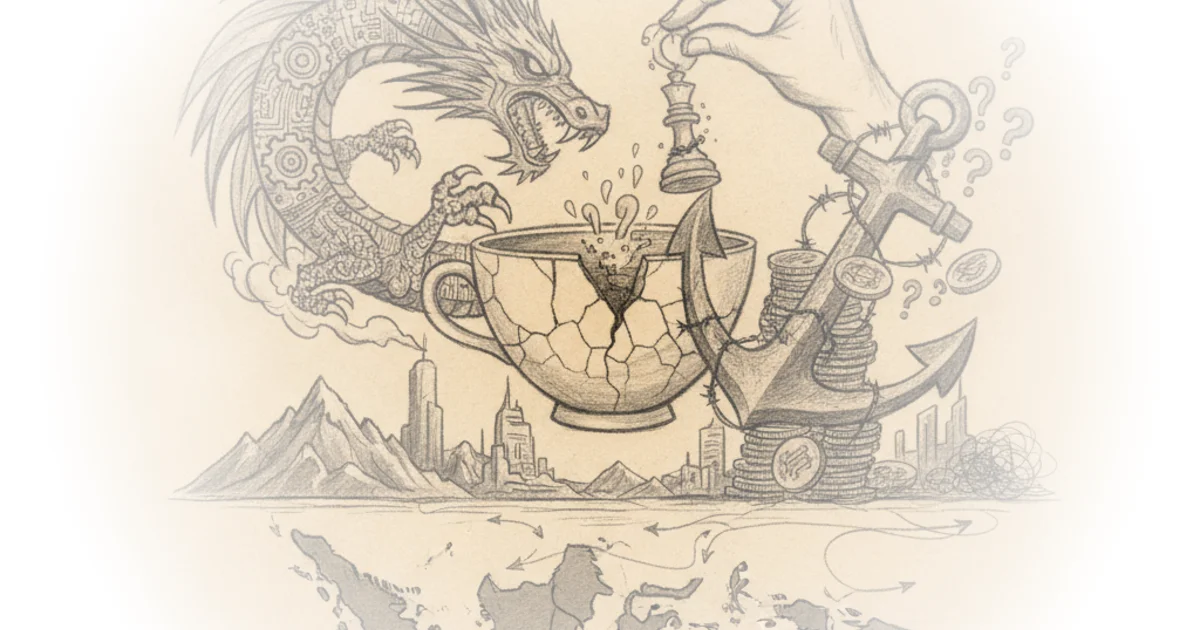
The most alarming development Schriver highlights is the recent announcement of a persistent Coast Guard patrol east of Taiwan. This is not a random deployment; it is a calculated move to normalize Chinese law enforcement in waters previously considered international. Schriver explains the mechanism of this coercion: "They integrate lawfare, political warfare, information warfare." By querying commercial vessels or rescuing distressed fishermen, Chinese forces create a scenario where responding to them becomes a de facto acknowledgment of sovereignty. As Schriver puts it, "They've actually just physically made manifest their sovereignty claim." This tactic is insidious because it creates a "grey zone" where no shots are fired, yet the status quo is irrevocably altered. It mirrors the tactics seen in other flashpoints, where the slow accumulation of small, legalistic actions creates a fait accompli before a formal conflict ever begins.
They integrate lawfare, political warfare, information warfare. One of the most significant developments of the last few weeks is the announcement of a persistent Coast Guard patrol east of Taiwan.
Critics might argue that commercial ships responding to Coast Guard queries is a matter of safety and insurance, not political capitulation. However, Schriver's point is that the pattern of behavior, repeated over time, normalizes the intrusion. The human cost here is the erosion of a nation's right to self-governance, achieved not through invasion but through administrative suffocation.
The Erosion of Credibility and the Law
The commentary takes a sharp turn when addressing the reliability of the United States as a security partner. Schriver expresses deep concern over recent rhetoric from the White House, specifically the characterization of arms sales as a "bargaining chip." This framing directly contradicts the legal obligations established by the Taiwan Relations Act. "I would submit that puts us firmly out of compliance with the law," Schriver states, emphasizing that the Act mandates the provision of defensive weapons. "It's not a choice, it's not a policy option."
When the executive branch treats statutory requirements as negotiable leverage, it signals to allies that the United States is no longer a predictable guarantor of security. Schriver warns that this approach absorbs the adversary's narrative, noting that statements like "we don't want to fight a war 9,500 miles away" ignore the reality that US forces are already stationed in Guam, Hawaii, and Japan. The distance argument is a convenient fiction that ignores the forward-deployed nature of American power. By framing the conflict as a distant burden rather than a direct threat to the regional order, the administration risks undermining the very alliances that make forward deployment possible.
This hesitation has tangible consequences. Schriver points to the US-China Economic and Security Review Commission's recommendation to "show your homework, do the math" regarding the capacity to resist force. With ongoing conflicts in Ukraine and Iran draining munitions stocks, the question of whether the US can actually sustain a high-intensity conflict in the Pacific is no longer theoretical. "They're pitching, I'm not catching," Schriver admits, highlighting a gap between rhetorical commitment and material reality. This disconnect is dangerous because it invites miscalculation by adversaries who may believe the US will not follow through on its threats.
The Hedging Gamble and the Nuclear Threshold
As trust in the US security umbrella wavers, regional partners are beginning to hedge their bets in ways that could destabilize the entire region. Schriver observes that countries like Japan and the Philippines are accelerating their defense capabilities, doubling budgets and expanding access to strategic islands like Yonaguni. While these moves are technically what Washington has long encouraged, Schriver warns that they are increasingly driven by a lack of faith in American reliability rather than a desire for partnership. "If it's still the result of a hedge and starts to accelerate because they don't believe in the credibility of the alliance or the United States, then we tip into another era," he argues.
The most terrifying indicator of this shift is the growing discussion of nuclear proliferation in South Korea and Japan. Schriver notes that popular sentiment in South Korea favors an independent nuclear capability, a view that is "extraordinary" but potentially ill-informed about the geopolitical fallout. If Seoul and Tokyo pursue nuclear weapons, the region could spiral into a multipolar arms race reminiscent of the pre-WWI era. Schriver describes this scenario as a "dark outcome," where the absence of a unifying US leadership allows national interests to drift toward catastrophe. "You have this notion of a trapeze artist — you really don't want to let go of one thing that's been pretty good to you until you get your hand on the other thing," he says, illustrating the precarious nature of the current transition.
The risk is compounded by the "axis of autocracy"—a loose but effective collaboration between China, Russia, and North Korea. Schriver dismisses the idea that this is not a formal alliance as a weakness, arguing instead that it is a strategic preference that allows for deniable cooperation. "Even limited cooperation can sure be consequential," he warns, citing North Korean artillery support to Russia and Chinese technology transfers for drones. In a conflict over the Korean peninsula, South Korea would face a coalition of adversaries with the capacity to overwhelm its defenses without direct US intervention.
If South Korea goes nuclear... that would be a step beyond the minor hedging and outreach we're seeing right now. That would be a step beyond the minor hedging and outreach we're seeing right now.
The Human Cost of Strategic Failure
The conversation concludes with a sobering look at the potential for conflict. Schriver discusses the concept of a "Hellscape"—a defensive strategy designed to inflict such high casualties on an invading force that the cost of war becomes prohibitive. While militarily logical, this strategy implies a future where the first responders are autonomous robots and coastal missiles, turning the coastline into a kill zone. The human cost of such a scenario is staggering. If the US fails to maintain a credible deterrent, the alternative is not peace, but a war fought on terms that maximize destruction.
Schriver also touches on the vulnerability of Taiwan to a blockade, noting that cutting off liquefied natural gas imports could force a capitulation without a single shot being fired. This highlights the fragility of modern economies and the ease with which coercion can be applied. The focus on breaking a blockade shifts the conversation from the glory of battle to the grim reality of starvation and economic collapse. It is a reminder that in modern warfare, the most effective weapon is often the ability to deny a population the resources needed to survive.
Bottom Line
Randy Schriver's analysis is a stark warning: the US is losing the Indo-Pacific not through military defeat, but through a slow erosion of legal and strategic credibility. The strongest part of his argument is the identification of "lawfare" as the primary tool of Chinese expansion, a tactic that is difficult to counter with traditional military means. His biggest vulnerability, however, is the assumption that allies will remain patient while the US recalibrates its commitment; the rapid acceleration of nuclear hedging suggests that patience may already be exhausted. The reader must watch for the next major shift in US arms sales policy or a formal nuclear announcement from Seoul, as these will be the canaries in the coal mine for a region on the brink of a new, dangerous era.