In a cultural moment saturated with toxic positivity and performative optimism, Sarah Bessey and Shannan Martin offer a startlingly practical alternative: the deliberate act of doubling down on the weight rather than trying to shed it. This conversation moves beyond the tired self-help trope of "counting blessings" to propose a radical physics of the soul, arguing that hope is not found in ignoring the darkness but in balancing it with equally heavy pockets of goodness. For the busy reader navigating a world thick with anxiety, this is not a call to retreat, but a manual for staying tender without breaking.
The Physics of Hope
Bessey introduces Martin not merely as an author, but as a voice of "reality" who refuses to sanitize the Christian experience. The core of Martin's argument rests on a simple, blue-collar metaphor provided by her father: "carrying something heavy becomes more efficient, more doable, if we carry something equally heavy in the other hand." This reframing is the piece's most potent contribution. It rejects the binary choice between numbness and despair, suggesting instead that survival requires a redistribution of load.
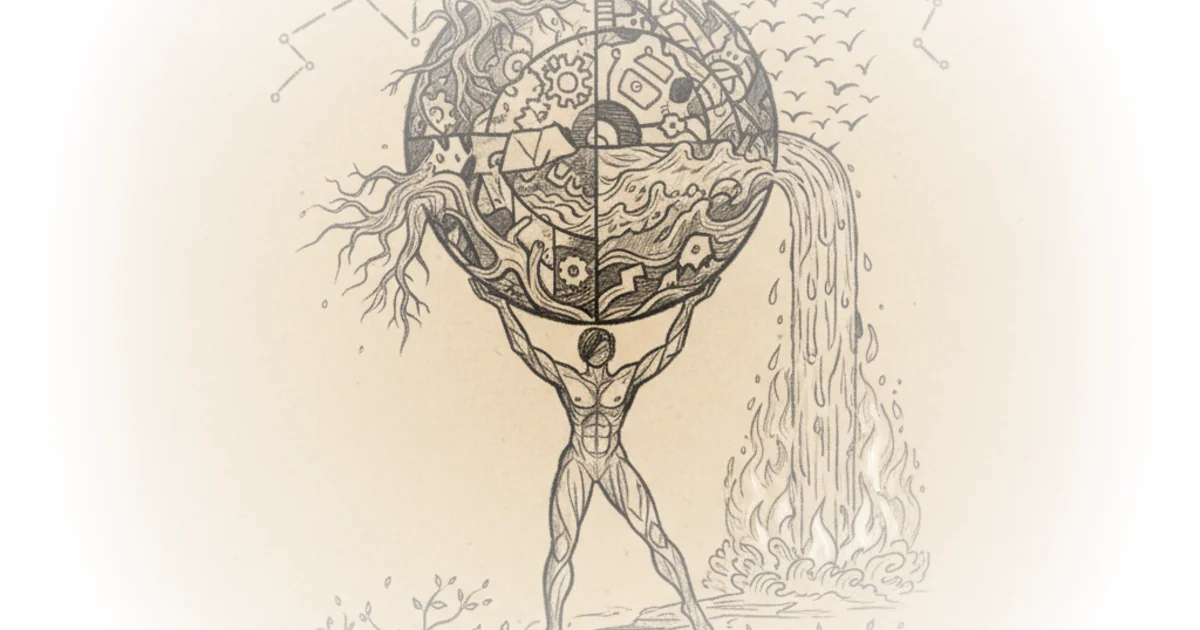
Martin explains that the modern condition feels like "the anxiety in the air thickened into a fog," where every hour brings a new terror. Traditional self-help often asks us to ignore this fog, but Martin insists we must "tilt the scale toward goodness" by actively loading the other side of the scale with "heavy goodness." This is a crucial distinction. It is not about minimizing pain; it is about refusing to let pain be the only thing with mass in our lives.
"Abundance isn't experienced merely by counting our blessings but by countering our weights."
The argument holds up because it acknowledges the physical reality of grief. When Martin notes that "we can only counter what we're willing to weigh," she challenges the reader to stop treating sorrow as an anomaly to be fixed and start treating it as a constant to be managed. Critics might argue that this approach risks romanticizing suffering or placing the burden of emotional regulation entirely on the individual. However, Martin's framework is deeply communal, suggesting that the "counterweights" are often found in the shared, mundane acts of life rather than solitary spiritual exercises.
Redefining Abundance
The conversation takes a sharp turn when addressing the "prosperity gospel" and the promise of an "abundant life." Martin, drawing on her own history in charismatic spaces, dismantles the idea that abundance means a life free of pain. She writes, "The abundance is not just the good stuff. We get it all. Every drop, every dreg - the good, the terrible, the 'Who even knows?' That's the deal." This is a necessary correction to a theology that often functions as a form of "magical thinking," where admitting to pain is seen as a failure of faith.
Martin's journey from a "hyper-spiritualized" view of Christianity to a grounded reality was catalyzed by proximity to incarcerated people and those struggling deeply. She observed that "our friends taught me the freedom of telling the truth about grief, disappointment, pain, doubt, and failure." This shift from performance to honesty is where the "counterweight" practice becomes a spiritual discipline. It aligns with a broader historical critique found in Mennonite theology, which has long emphasized the "way of Jesus" as one of suffering and service rather than triumphalism. By grounding abundance in the "white-hot center of reality," Martin makes the concept accessible to those who have been alienated by the demand for constant cheerfulness.
"True abundance means we get it all. Our job is to figure out how to carry it, preferably together."
This section effectively bridges the gap between personal spirituality and social justice. Martin argues that we cannot "create a better world if we don't remember why, in spite of it all, there's still so much to love about life." The counterweight is not a distraction from justice; it is the fuel that allows one to "work for the peace and prosperity of your city" without burning out. As she paraphrases Jeremiah 29:7, the order matters: "work" first, then "pray." This prioritizes action over passive wishing, a stance that resonates with the historical tradition of charity shops and thrift stores where community is built through the shared labor of care rather than abstract charity.
The Sacredness of the Ordinary
Perhaps the most surprising element of the discussion is the elevation of the mundane. Martin and Bessey celebrate "chain grocery stores," "thrifting," and "ordinary not-photo-worthy meals" as legitimate sources of spiritual sustenance. Martin describes thrifting as an "evergreen counterweight," noting that "beauty is often found in humble places." This is a direct rebuke to the curated, Instagram-perfect lives that often exacerbate feelings of inadequacy.
The authors argue that in an era of division and AI-generated content, there is nothing more grounding than "gathering with the ones who know the truest version of you." This focus on local, embedded community is a strategic response to the isolation of modern life. Martin notes that community "has to be built" and requires "time and sweat and awkwardness." It is not about finding a pre-existing tribe but "recognizing your people" within reach. This practical approach to belonging offers a tangible path forward for those feeling overwhelmed by global crises.
"Justice and beauty intersected in the neighbourhood; I wanted to spend my life in its bull's-eye."
The conversation also touches on the pain of institutional failure, with Martin being candid about the "catastrophic" fallout with her former church. She validates the widespread experience of feeling "hurt, betrayed, or even being harmed by a church," acknowledging that "powerful institutions seek to silence those who seek justice." Yet, the counterweight here is the restoration of faith in "the gathering of ordinary saints." This nuance is vital; it allows for a critique of power structures without succumbing to cynicism, a balance that is often difficult to strike in religious discourse.
Bottom Line
The strongest element of this piece is its refusal to offer a quick fix, replacing it with a sustainable, physical metaphor for emotional endurance that feels both ancient and urgently modern. Its biggest vulnerability lies in the sheer energy required to maintain this balance; for those in the depths of acute trauma, the discipline of "loading the other side" may feel insurmountable without significant external support. Readers should watch for how this "counterweight" philosophy translates into political action, as the text hints that staying whole is a prerequisite for effective justice work, but does not fully map the path from personal resilience to systemic change.