The Tower as Workplace
PILCROW's "Onboarding in the tower of babel" reframes the ancient Genesis story as a corporate satire—the Tower of Babel becomes a sprawling institution where refugees seek employment, HR departments dictate language, and identity is reduced to a clay ID card. The piece merges biblical mythology with modern workplace alienation, producing something that reads like Kafka meets Genesis.
Arrival and Transaction
The protagonist Ishkebek arrives at the tower as a refugee from a destroyed town, exhausted and filthy. PILCROW writes, "I pushed through the crowds to touch its dirty outer wall, just to confirm that either it or I actually existed." The tower is overwhelming—gorgeous, terrifying, impossible. But awe quickly becomes transaction.
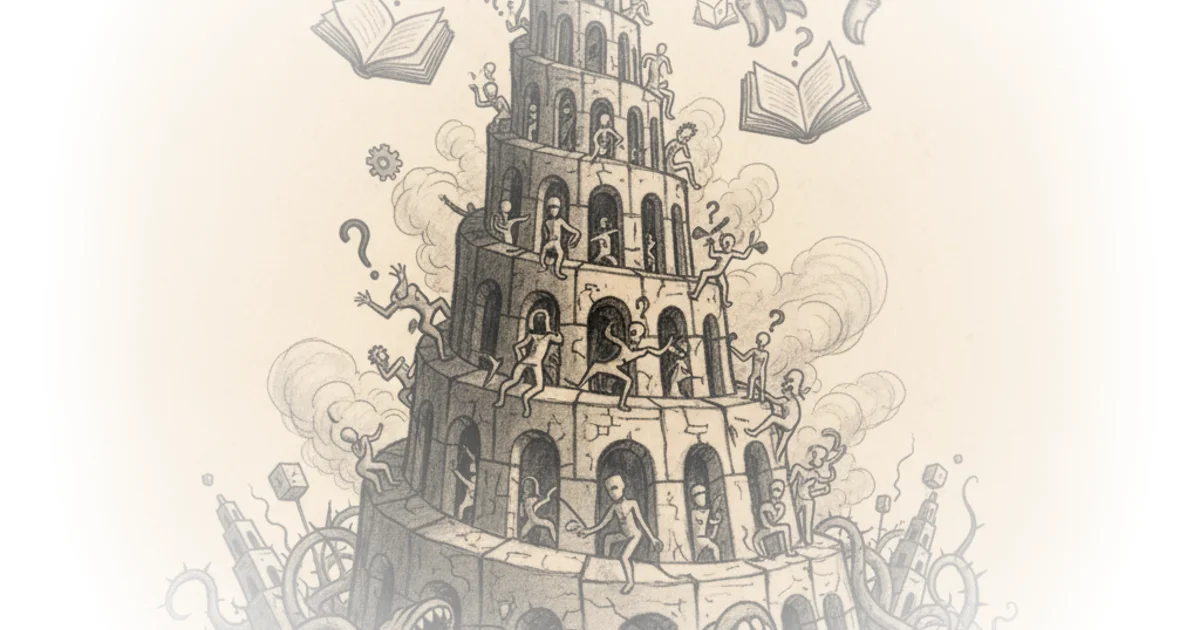
As PILCROW puts it, "Nimrod's immense tower proposed a simple exchange. Some part of me for some part of it, roughly." Ishkebek agrees, despite carrying "the ashes of my kin still in my fingernails and hair." The institution absorbs the orphan, granting belonging at the cost of surrender.
"Her life—all of our lives—are just so much small talk pasted on blind force."
The HR Machine
The hiring process satirizes modern human resources with brutal precision. A weary HR woman tells Ishkebek not to say "landing" when referring to floors—too many interns jumped. The wind determines hiring; a Festival of Layoffs comes with the new moon. PILCROW writes, "We're always hiring," but the reality is cyclical disposability.
The HR woman coaches Ishkebek to reframe his past: "Maybe I worked closely with the general and his executive staff to craft compelling, high-impact directives to a diverse body troops that led to deeper corps-wide cohesion." The language is contemporary corporate speak imposed on an ancient setting—an army becomes a team, survival becomes adaptability.
Critics might note the satire leans heavily on familiar workplace tropes—HR as dehumanizing, corporate language as hollow. The piece assumes readers recognize these patterns from modern tech or finance culture, which may limit its resonance for those outside those institutions.
Orientation as Indoctrination
The Anti-Abomination Orientation is a daylong recitation of corporate values. PILCROW writes, "The content of the orientation hardly seemed worth mentioning, never mind the scrolls, the catered lunch, and all of the candles." Ishkebek is distracted by the women—impassive, sophisticated, unobtainable—and by the sheer spectacle of a thousand candles.
The ID card becomes identity. PILCROW writes, "My name is Ishkebek, but that's just more weather, filler, grease for the axle." Between Nimrod's stamp and the protagonist's name lies a vertiginous chain of titles—Vice Nimrod, Executive Vice Nimrod, Executive Commanding Vice Nimrod—that map the power gulf. The ID grants access, safety, desirability. "In the most practical sense, it made me a full person."
The Unreliable Narrator
Ishkebek confesses his unreliability: "I am what the ancients would have called an unreliable narrator, but not because I mean to deceive. I've simply gotten too good at lying, and deceive even myself without meaning to." His father, a stonemason, told him only scribes steal more than they lose. The narrator works with words, not bricks—more dangerous, more corruptible.
PILCROW writes, "The tower is real." Everything else is fragment, farce, weather. The institution survives; the individual adapts or disappears.
Bottom Line
PILCROW's retelling succeeds as institutional critique—the Tower of Babel becomes any modern corporation where language is policed, identity is issued, and loyalty is traded for survival. The biblical framework adds weight; the workplace satire adds sting. But the piece's strength is its honesty about complicity: Ishkebek knows the transaction, accepts it, and becomes part of the structure that erases him. The tower wins.