Nate B Jones delivers a jarring but necessary correction to the current AI narrative: the bottleneck isn't your tool stack, it's your human coordination overhead. While most observers celebrate the "80% AI, 20% human" formula, Jones argues that the missing variable isn't technical skill, but the psychological capacity to act on intuition without committee approval. He posits that the most productive workers aren't those with the best prompts, but those who have mastered the feedback loop between taste and conviction.
The Coordination Trap
Jones begins by dismantling the assumption that solo founders succeed because they lack complexity. He asserts that "your most extraordinary people are operating at 25% of their actual capacity," trapped by the endless cycle of "syncs, the scheduling, the meetings, the emails." This is a provocative claim, yet it is supported by a striking Harvard Business School field experiment involving 776 professionals at Proctor & Gamble. The study found that individuals using AI were "three times more likely to produce ideas in the top 10% of quality," effectively allowing a single person to match the output of a two-person team.
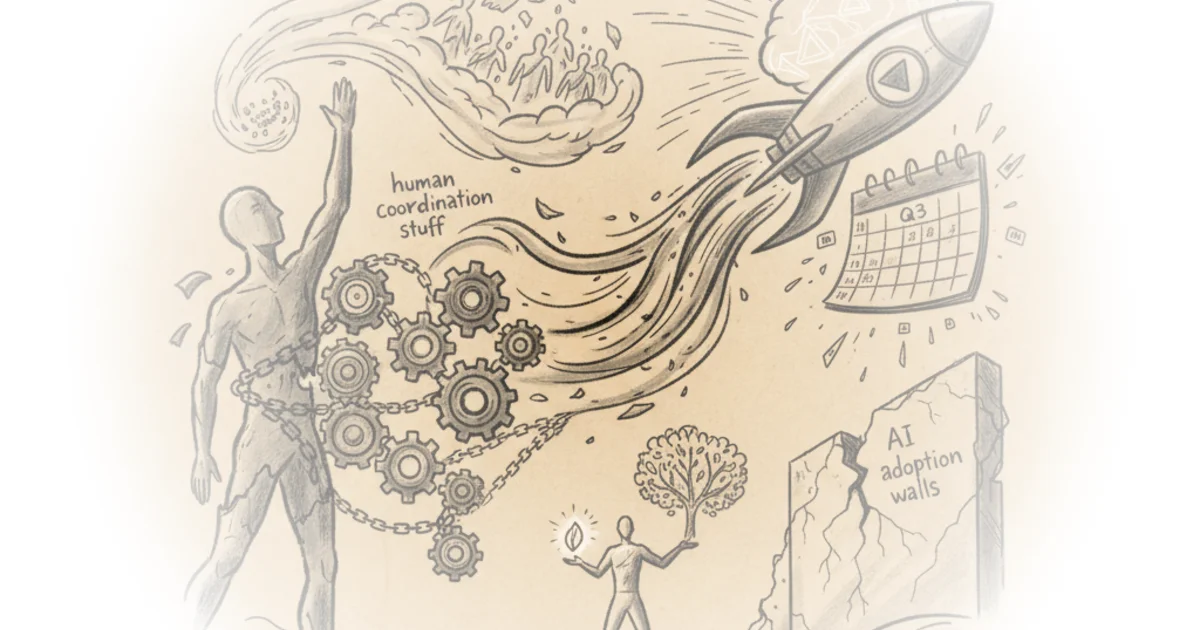
The author suggests that AI acts as a "coordination value ad," breaking down functional silos by allowing a marketer to generate technically grounded ideas without waiting for an engineer. This reframes AI not as a productivity hack, but as a structural equalizer that mimics the synthesis usually achieved through expensive human collaboration. Critics might argue that this ignores the nuance of legacy systems and deep domain knowledge that solo founders often bypass, but the data on idea quality suggests the coordination cost is indeed the primary drag on enterprise innovation.
"AI is providing a proxy for that technical ad in a way that's genuinely useful that saves a ton of time."
Taste vs. Conviction
The piece's most distinctive contribution is the shift from "taste" to "conviction." Jones observes that while "taste is a word that we have used as a proxy... for one of the things that we think has value," it is insufficient without the willingness to ship. He illustrates this with Ben Sira, a solo founder who rejected standard design norms for his AI product, noting that "nobody asked him to make those individual product decisions... He just had conviction."
Jones defines the distinction sharply: "Taste can evaluate, but conviction is what we actually need to ship." He argues that the current discourse overemphasizes the ability to judge quality while underestimating the courage required to execute against that judgment. This is a crucial insight for leaders who often hire for "good taste" but fail to cultivate the environment where employees feel safe to bet on their own instincts.
"If you just do taste, we don't ship. And if you just do conviction, we're going to ship wrong."
The author describes this relationship as a "virtuous flywheel," where acting on conviction generates the feedback necessary to refine taste. This challenges the traditional corporate model where decisions are delayed until consensus is reached. Instead, Jones advocates for a "speed of control" rather than just a "span of control," referencing the 2017 paper "Attention is All You Need" to suggest that human attention management is now as critical as managing AI agents.
The Human Element in an AI World
Ultimately, Jones contends that the path to unleashing talent lies in upskilling existing teams rather than hiring new ones, because "99% of the time it is better to upskill the talent you have on the team because they know you." He warns that without the ability to direct AI with conviction, "the tools are going to end up managing you."
This is a sobering reminder that as AI lowers the barrier to execution, the premium on human judgment and the courage to act rises. The author's focus on soft skills as the differentiator in an AI-native world is a compelling counter-narrative to the tool-obsessed culture of the moment.
"The people who do the best with AI tend to have the conviction to drive AI according to their taste."
Bottom Line
Jones successfully identifies that the next frontier of AI productivity is psychological, not technical, arguing that conviction is the engine that turns good taste into shipped products. The argument's greatest strength is its reliance on concrete data from the P&G study to validate the solo-founder model within enterprise contexts, though it risks underestimating the friction of integrating these "conviction-driven" workflows into rigid corporate hierarchies. Leaders should watch for how they can restructure feedback loops to reward speed and action, rather than just consensus.