The Video Call That Was Not About the Video Call
On February 4, 2026, Vladimir Putin and Xi Jinping held a scheduled video call -- their sixth annual start-of-year conversation. The surface-level choreography was familiar: mutual New Year greetings, references to the lunar calendar, talk of spring and renewal. Putin noted that the call fell on Lichun, the beginning of spring, and offered that in Russia-China relations, "spring continues throughout the year, no matter the season." The pleasantries were warm, practiced, and almost entirely beside the point.
The call's real significance lay in what Joseph Webster of the China-Russia Report identifies as the growing tension between Beijing and Moscow over the prospect of a regional war involving Iran. According to Axios, U.S.-Iran talks were collapsing at the time, and the probability of armed conflict in the Middle East was rising sharply. Three days before the video call, Chinese Foreign Minister Wang Yi had met with Russian Security Council head Sergei Shoigu in Beijing -- a meeting that itself appeared to surface divergent perspectives, as Wang distinguished carefully between "respective and common interests."
Structural Divergence on Energy
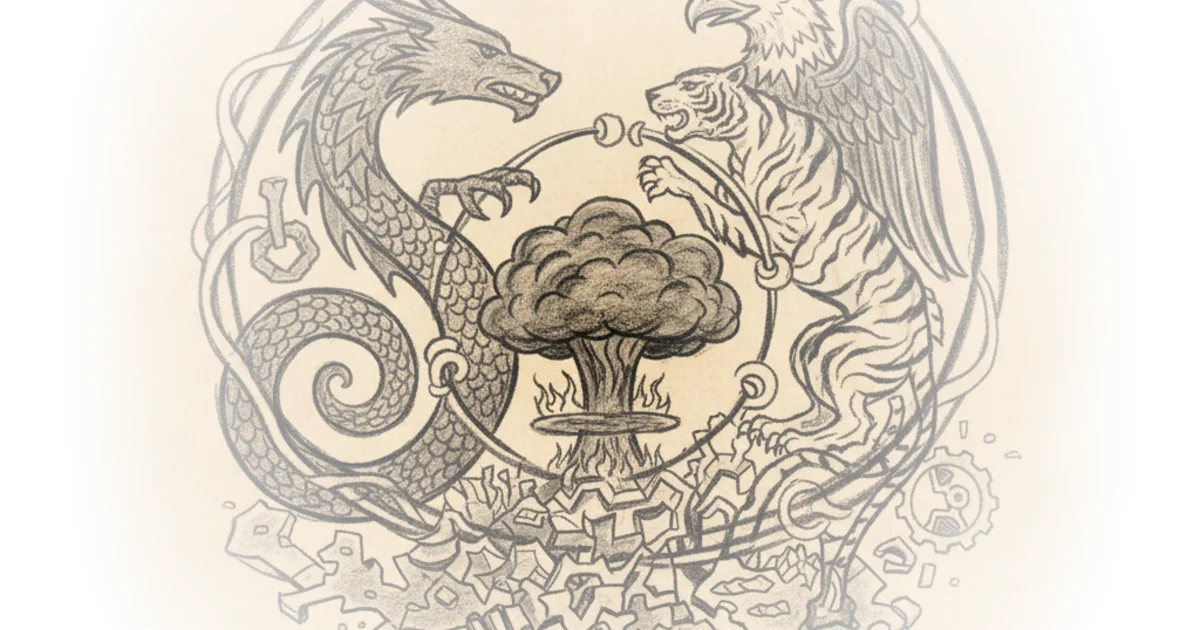
The core tension is not ideological. It is structural. China is the world's largest energy importer. Russia is one of the world's largest energy exporters. A sustained disruption to Middle Eastern energy production -- the kind that an armed conflict with Iran could trigger -- would produce opposite effects for each country. China would face worsening terms of trade as oil prices spiked. Russia's energy revenues could surge.
Webster frames this bluntly: the two countries have "structurally different interests" in energy markets. Moscow does not wish to be seen as encouraging instability in the Middle East, given its own diplomatic and commercial relationships in the region. But the economic incentives point in an uncomfortable direction. Russian energy exports would benefit from precisely the kind of disruption that would damage Chinese interests.
This divergence surfaced in the language both leaders used. Putin appeared to minimize the significance of potential conflict. In the Kremlin's English-language readout, he expressed confidence that Russia-China relations would continue to develop:
I am confident that they will remain resilient and will continue to steadily develop across all sectors regardless of momentary international developments.
That word -- "momentary" -- is doing significant work. Webster interprets it as Putin's way of suggesting that any U.S.-Iran conflict would be sharp and short, similar to the June 2025 intervention. Whether or not Putin genuinely believed this, the framing served to downplay the very scenario that most concerned his Chinese counterpart.
Xi's Careful Alarm
Xi Jinping's language struck a markedly different tone. Where Putin invoked seasonal metaphors and suggested transience, Xi reached for the institutional architecture of global order:
Since the beginning of the year, the international situation has become increasingly turbulent. As responsible major countries and permanent members of the UN Security Council, China and Russia have an obligation to promote the international community's adherence to fairness and justice, firmly defend the achievements of the victory in World War II, resolutely uphold the international system with the UN at its core and the basic norms of international law, and work together to safeguard global strategic stability.
This is not the language of a leader who considers current developments "momentary." The invocation of the UN Security Council, international law, and "global strategic stability" suggests a leader preparing to argue for restraint -- and positioning himself to hold his partner accountable if restraint fails. Xi's phrase about "jointly shouldering our responsibilities as major countries" appears to be a direct reference to the Iran situation, framed as an obligation rather than an opportunity.
The asymmetry is notable. Putin spoke as though the partnership itself was the subject. Xi spoke as though the partnership might be tested by events neither leader fully controlled.
The Ushakov Readout and the Machinery of Coordination
Perhaps the most revealing document from the exchange came not from either leader but from Russian Presidential Aide Yury Ushakov's post-call commentary. Ushakov reported that Putin and Xi had agreed to maintain permanent bilateral consultation mechanisms across security councils, foreign ministries, and defense agencies. The Kremlin's language was unusually specific:
This pertains to the swift alignment and coordination of approaches on current matters, including sensitive ones, to ensure timely responses to emerging challenges and threats.
The phrase "sensitive ones" is diplomatic shorthand for issues where the two sides do not yet agree. That they needed to establish -- or rather reaffirm -- mechanisms for "swift alignment" suggests the existing channels had proven insufficient for the pace of events. When allies need to build new coordination infrastructure in the middle of a crisis, it typically means the crisis has outpaced their ability to manage disagreements through normal channels.
Ushakov also noted that Russia-China relations "are not subject to short-term political considerations," which Webster flags as potentially referring not only to Iran but also to Beijing's growing commercial ties with Western countries, particularly European ones. China has been deepening trade relationships with nations that are also major energy importers -- countries whose interests on Middle Eastern stability align more closely with Beijing's than with Moscow's.
The Trade Numbers Tell Their Own Story
Both leaders acknowledged that bilateral trade had experienced what Putin delicately called "an adjustment of indicators" -- a decline from recent highs, though still above $200 billion for the third consecutive year. Webster's commentary is pointed: the trade totals have been constrained by China's purchasing of heavily discounted Russian oil and by Russia's restrictions on Chinese exports, especially vehicles.
The energy trade itself contains seeds of future friction. China is unlikely to need or desire additional Russian natural gas volumes. Chinese refineries face physical limits on how much Russian crude they can process. Meanwhile, Chinese exports to Russia in solar, batteries, and electric vehicles remain at low levels, held back by Russia's own political economy barriers. The economic relationship, in other words, is not the seamlessly complementary partnership that summit communiques describe. It is a relationship shaped by asymmetric dependencies, trade restrictions, and competing interests -- one that could come under significant strain in a post-war period.
The Third Call
Xi also spoke with Donald Trump on February 4. The Chinese readout focused almost entirely on Taiwan, not the Middle East. Trump's Truth Social post about the call mentioned Taiwan, potential U.S.-China trade purchases, Russia's invasion of Ukraine, and "the current situation with Iran." The White House did not issue a formal readout.
That Xi conducted both calls on the same day is itself significant. Beijing was working the phone -- managing its relationship with Moscow while simultaneously engaging Washington. The fact that the Chinese readout of the Trump call emphasized Taiwan rather than Iran may reflect a deliberate sequencing: Taiwan is the issue where Beijing wants assurances from Washington, while Iran is the issue where Beijing needs coordination with Moscow. Different conversations for different dependencies.
What Was Not Said
A counterpoint is warranted. The China-Russia partnership has weathered significant stresses before -- the invasion of Ukraine, Western sanctions pressure, competing influence in Central Asia -- without fracturing. The structural energy divergence over Iran, while real, may not be severe enough to alter the fundamental alignment. Both countries share an interest in constraining American power projection, and that shared interest has consistently proven more durable than the specific economic frictions of any given crisis.
It is also worth noting that Ushakov's readout stated the two sides' positions "on the overwhelming majority of international issues are similar or fully coincide." The implication, as Webster observes, is that they do not always align -- but the emphasis remains on convergence. Diplomatic language that acknowledges disagreement while emphasizing agreement is not the language of a partnership in crisis. It is the language of a partnership under management.
Bottom Line
The Xi-Putin video call of February 4, 2026, was a scheduled event that acquired unscheduled urgency. The collapse of U.S.-Iran talks forced both leaders to confront a question their partnership had largely been able to defer: what happens when the world's largest energy importer and one of its largest energy exporters face a crisis that benefits one at the expense of the other? Putin's answer was to minimize the stakes. Xi's answer was to invoke the institutional obligations of major powers. Neither answer resolved the underlying tension. Webster's analysis, layered through the official readouts with surgical precision, reveals a partnership that remains strategically aligned but is beginning to encounter the limits of structural compatibility -- limits that a Middle Eastern war would expose with uncomfortable clarity.